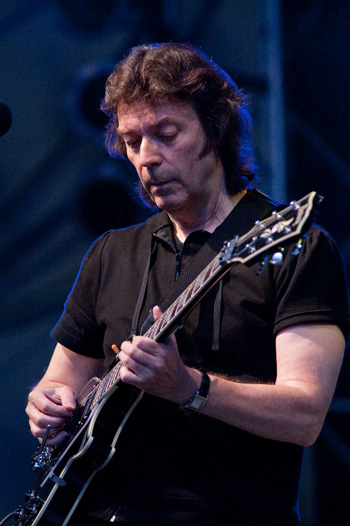
Chris Squire and Steve Hackett are both musical legends. They have been in the upper strata of the world's most incredible musicians for over forty years. Each writes, plays, and sings a challenging sort of music that has come to be known as prog, or fully, progressive rock. Both served time in huge and innovative bands - Squire in Yes, and Hackett in Genesis. Now, the pair have combined to record an outstanding record that highlights the exact skills that have kept them employed, and in the public eye for so many decades. With a nod, I am assuming, to their very Englishness and the humor presumed within, they have chosen a rather awkward, and perhaps silly name. A name I happen to like, but some may find disturbing - a name that belies the wonderfully melodic, dynamic music found in their new record's grooves.
If you're wondering about the title of this review, I'll explain. It is a question that dawned upon me as I heard some very negative comments about Squackett. For the most part, the reviews of this album have been tremendously positive, as this one shall be, as well. However, these negative comments weighed on my psyche - Squire and Hackett have written and recorded their first outing as a team, and have obviously documented music that is very close to their hearts and personal. It is well produced and gorgeous, with both partners contributing to all facets of the production. They have laid their hearts and minds on the line as artists always have, so I would ask naysayers and critics one simple question:
What Shitty Band Are You In?
I can well understand that perhaps not every song of every project a musician may attempt will please every listener. It's appreciated that occasionally, a musician or band will make a misstep, or fail to connect in some way with some fan, some critic. However, for someone to dismiss a fine effort by two extremely seasoned professionals who have done their best and delivered a product well within the parameters of probability and acceptability causes me to wonder just what goes through the mind of someone who reacts with malice, and vitriol. Makes me wonder what they have done that enables and authorizes them to castigate so harshly. It makes me want to ask, "So, what shitty band are you in?"
I don't write about music I don't enjoy, it's that simple. Why would I? Why would I spend valuable time and energy with something that gave me no fulfillment? I could write from now until the very end of time, and not be able to fully express my thoughts about that which I do enjoy, so why waste time with grousing and deriding that which holds little value for me? I get little pleasure from disappointing or angering an artist, or an artist's fans, who most likely have no interest in reading what someone doesn't like about their favorites. I have less than no desire to be amongst the minions who rain down criticism from on high. I'd rather spend my time telling you what I do enjoy about the new Squackett album, and there is much that I enjoy.
I'll be the first to say that I like my prog with liberal dose of pop, and if there are some nice rocking guitars to go along with it, all the merrier. Squackett is above all a song album. Those looking for long stretches of virtuosity may be disappointed, though both Squire and Hackett provide a ton of fire power from their respective instruments.
Hackett's guitar playing is astounding - one minute he is chiming chirpingly and you are dreaming of Brit-pop of the ages, whether it be The Fab Four or XTC, then you blink and he is pushing a crescendo of rapid fire distortion through the atmosphere with his Fernandes Sustainer and Whammy pedal. His histrionics are equally acrobatic and lyrical - for all his shredding (and there is a good deal), his playing is marvelously melodic and in a most unpredictable manner. His style is his own, and his musicianship is developed to the point whereby his inspirations are a long forgotten memory, replaced by his own stamp of creativity. If Squackett were the work of a new talent we'd have a new guitar super hero - as it is we simply have an underrated one.
Chris Squire brings to the table much of what he has always brought. His wickedly wonderful bass playing, marked by the unmistakable tone of his signature series Rickenbacker 4001S coming through a combination of amps and effects, and most generally including a 100 watt Marshall guitar amp, has never been more welcome. Almost identifiable as his playing is his angelic vocal cords, which rang so soothingly next to Jon Anderson's for so many years and records with prog superstars, Yes. Here, the vocals are shared with Hackett (each singing lead on their own compositions) - they weave in, out, and around one another as if they have been doing so forever. Harmonies, unisons, and stacked vocal configurations abound as the vocals throughout the album bring to mind CSN&Y, and The Hollies as much as the pair's prog past. While admittedly there is not a lead voice as distinctive as Anderson in Yes, or Gabriel in Genesis, you will still walk away having listened to one of the most impressive vocal productions in a great while. In a day when harmony, background, and group vocals are relatively rare, this album is a vocal treasure chest.
The album also has a somewhat secret weapon - it comes in the form of longtime a Hackett cohort, producer and keyboardist Roger King. Throughout the proceedings, King does a fantastic job. To my ears this is everything the last Yes album wasn't, but should have been. As a producer, he has done a marvelous job of putting together a record that sounds wonderfully cohesive, especially given that in all likelihood there was little time to woodshed the material, or for the band to spend much time actually in the same room. This is just part of the way that many project type records are made these days due to economic necessity and the fact that a musician can't stand still for long and earn his daily bread. The job that's been done here is pretty great - much akin to the job done by Bill Evans and the members of Flying Colors on their stunning debut earlier this year.
King also provides fabulous atmospheric keyboards on every cut, proving the essential glue that holds together the huge instrumental talents of Squackett. This record sounds like a band, as opposed to this song by Squire, this song by Hackett - there isn't the tremendous amount of challenging interplay that existed in 1970, but it's important to realize that firstly, that is not what these two have set off to create, and secondly, that type of instrumental sophistication requires a great deal of time, rehearsal, and collaboration that is again just not always possible in this day and age. It's not just prog, look at the dearth of cool jazz fusion, or even elaborate pop. You'll not soon see again the like of Sgt. Pepper in this market. That having been said, you should be even more impressed by the job that has been done here. Hackett did well to bring King into this project, and King has done a masterful job.
The songs....
A Life Within A Day - Epic prog/pop. There are those who say mentioning Zeppelin here is inappropriate, but that would be like not acknowledging the 800 pound gorilla in the corner. Of course the chugging, mid-tempo, Eastern riffing evokes Kashmir. However, there is also the fabulous intro that is pastoral and elegant. Then there is the solo section that takes off on an incredible path, leaving behind anything reminiscent of LZ's blues rock - Hackett lets loose with some heavily effected, dissonant squalling that somehow remains wonderfully melodic, as Squire underscores his soloing with some characteristically furious busyness. As these two instrumental giants joust, Roger King is fast in the thick of it, and the entire section becomes a fantastic journey that finds the listener gripping his chair, and holding his breath. Alas, they pull out of it having avoided disaster and then it's back into the now familiar riff, and vocals that by now have you singing along. Amazing as the rifled riffing is here, it is the song you walk away singing.
Tall Ships - Enters with Hackett gently playing some acoustic guitar that ends with a brief flamenco flourish after which Squire brings some fabulously funky bass work into the mix. This swings and dances a bit much for prog, as drummer Jeremy Stacey provides some Purdy-esque fatback beats and Hackett joins in with rhythmic stabs that would make Nile Rodgers grin. The melody comes in and it's a cool combination as East meets West - imagine a Crosby, Stills, and Nash album with some vindaloo on the side, and you're about there. A great chorus, and another brilliant Hackett solo. The harmonies are tight and intoxicating, and if there was still real radio, this would be a big summer smash.
Divided Self - A great dose of Brit pop that's wise lyric may be lost in the happy sonic landslide that sees both Steve and Chris strapping on Rickenbackers to perfect effect - Hackett both chimes and plays great fills (exactly in the style of the great tradition) as Squire reminds us that XTC's Colin Moulding may have listened to a few Yes albums on his way to greatness. It's a joy to listen to Squire playing marvelously busy, melodic, and effective bass under Hackett's solo. Two absolute masters of their craft - you can almost hear them listening to one another and reacting in the instrumental sections. If there's not enough playing on this record, you're really not listening very closely.
Aliens - A Squire tune that sees Hackett, King, and Stacey providing some gentle backing that keeps things moving while the bassist weaves his tale of extraterrestrial possibilities.
Sea Of Smiles - This song is going to set the bar awfully high for this summer's later entry in the prog/pop sweepstakes when John Wetton brings out this year's new model of Asia. If this had been released in 1980 it would have seen Squackett jetting to gigs with their name etched upon the back of a big bird's ass. This is a great piece of songwriting, and it's sweetened by loads of cool chops, great choral vocals, and another stunning Hackett solo. King's keyboards are outstanding on this cut - one minute he's playing rapid arpeggios, then he's back to plucky atmospherics, and soothing sheens of synth-work.
The Summer Backwards - More folkish, pastoral harmonies, and some gorgeous melodies abound that again seems to having Squackett thanking Andy Partridge for thanking them. This would fit lovely on XTC's Skylarking, one of the truly classic summer pop records. This one is Hackett's, and it is much lighter in tone and mood than much of his recent solo output.
Stormchaser - A bit of Squackett metal. Very reminiscent of Hackett's solo rock, and it makes me wonder how Hackett has avoided greater acclaim. You can literally hear the band being formed on this cut. It's an early arrival and you can sense that this was the jumping off point. Squire's bass is belligerent and rude - it's clearly Hackett's riff, but the bass man is making his presence well felt. This will be a barnburner when these fellows hit the boards.
Can't Stop The Sun - I get the sense that Chris Squire has finally got his well-deserved obsession with The Beatles out of his system a bit with Squackett. The marriage of melody, harmony, and a bass driven engine is beautifully executed, and we have another tale of the philosophies of love that is as pleasant in the light of day, as it is at midnight. That's a fascinating thing about this album - I've noticed that it delivers a wealth of sunshine and sunny weather, but also has a nice undercurrent that makes it quite good after midnight.
Perfect Love Song - The album's second absolute classic, and the perfect second side for the double sided single, next to Sea Of Smiles. This is all about the ear candy - it's gorgeous, well conceived, and executed with stunning precision. If you have qualms with this, I only ask - do you have a better piece of prog/pop up your sleeve? Great writing, much more than proficient playing, wonderfully soothing vocals, and a flash guitar solo. You kidding? This is great stuff. In the words of Steve Hackett, "A Perfect Love Song celebrates music
and love. Just when you think that life is cast in slabs of grey stone,
love kicks in and transforms everything. The song has an ascending
chord sequence and upbeat lyrics, rounding off one of the most rewarding
projects I've been involved with."
So, I'll end where I started with a simple question.
What shitty band are you in? Really, if you are amongst this record's critics, I'd love to hear what you have better to offer. In the meantime, lighten up and enjoy a cool, cool piece of music.
If this was a record by a bunch of unknowns, I suspect it would be lauded widely. If it had been released in 1972 as a side project between Yes and Genesis albums, it would have been acclaimed as the great success that it is.
Squackett is a great record. It does exactly what Squire and Hackett set out to do - record an album of songs that well represents their careers and talents. I congratulate and thank them, as I am personally enjoying it tremendously. It hasn't left my presence since it arrived, and it will most likely be a major part of the soundtrack to my summer. With that, I am well pleased.
My thanks to Steve Hackett, Jo Hackett, and Esoteric Antenna/Cherry Red Records.
Garbage has a new album, Not Your Kind Of People, and to these ears it sounds pretty fucking fabulous. I have to admit, I haven't listened to Garbage much in the past - let's just say I was busy when they were in their heyday and I'm just catching up and on.
If you're wondering about this review's title, here's the deal. While I haven't been terribly intimate with Manson, Vig, and Company in the past, I do have a bit of indie cred. I spent a great part of the last ten years living in the apartment below maybe the greatest American songwriter of the last twenty-five years, my old friend Robert Pollard, he of indie rock legends Guided By Voices. I've known Bob since I was ten years old, played with him in several bands, made a record or two with him, and served as musical director in his first post GBV project, The Moping Swans. I live in a town that drips indie, and while I am a bit more high tech, I get it. Pollard always bristled at those too lazy, untalented, and afraid to stick their necks out creatively, and once, upon being fed up with the non-doers unwillingness to do anything except bitch about what he was doing, he had some T-shirts printed up that said simply: Guided By Voices - "What Shitty Band Are You In?"
In tribute to my old pal, and everyone else over 40 and still having the balls and bluster to put out their art (such as Garbage), I ask those who sit back and criticize:
So - What shitty band are you in? If you're in no band at all, if you don't do anything towards making rock a better place, then perhaps you should take the advice that Barry Bonds couldn't. Maybe you should just shut the fuck up.
I first heard some material off the new record, and thought that it sounded just great. The songs sounded well written, the band is as tight as can be, the vocals great, and the production is superb. First thing I did was to read a few recent reviews. Most were pretty positive, but there was a good deal of print that chided the band for either not sounding up to their past, or trapped in and by said past. It was here that I feel I had an advantage. I could listen with fairly fresh ears - I was not jaded by their history, or even too familiar with their past. What I found, I liked, and liked a lot.
Automatic System Habit opens the record with an intro that made me think that if Cream's White Room had been written in this century it may have sounded a bit like this, then the band slams into a very modern rage against dishonesty. Shirley Manson's vocals are just great - she's obviously not lost a note in the seven years since the band's last record, 2005's Bleed Like Me. The guitars rage, fairly jumping out of the mix in your face, the drums pound with exuberance and precision, and there is enough electronica to keep things from ever being pedestrian. This is the sound of righteous indignation, of pissed offedness, and I like it. It rocks.
The next track, Big Bright World, delivers a huge dose of what I thought rock of the '90s promised, but never really delivered with regularity. None of the out of tune, out of time, unironed, unshaved mess of shit that I heard way too often throughout what I have come to call rock's lost decade. This sounds like a natural progression of where electronic pop should have headed after Bowie went to Berlin, and The Cure made androgyny so appealing. It's melodic, it's driving, and there's no shortage of delicious ear candy. Two tracks in, and I have no idea what any critic could find to bitch about.
If you can hear Blood For Poppies and not want to be whipping out this crazy cool guitar riff and dancing beside Manson as she delivers this tale, you're sure less ambitious than I. Any fan of rock should just be thrilled that they have something this good to listen to in this time of the Kali Yuga.
Not Your Kind Of People has instant classic written all over it. Manson delivers a tour de force, laying out the band's current manifesto, and displaying a knack for melody and phrasing that changes wonderfully in each of the song's luxurious sections. I listen to this and marvel at how hipster music journalists can harp about overproduction, or to call this pedestrian. I'm guessing these overpaid fucknuts have a negativity quotient they must hit, and since the band are recording and distributing on their own dime, these idiots' overseers don't have to worry about alienating advertisers or otherwise biting the hands that feed. This is an extremely satisfying listen. I love what the UK's The Guardian said about this track, "A beautiful, otherworldly cross between a John Berry Bond theme and a David Bowie outsider anthem."
This record is going to sound great onstage. It's relentless in its tones, textures, and melodies. Garbage sound hungry, angry, and pent up - never a bad thing in rock and roll.
Shirley Manson writes some fairly dark lyrics, and often seems to revel in this darkness, but through it all I can generally see a lot of light. Garbage come off as maybe the ultimate insider's outsiders. Over-talented in a time when talent is scorned, ambitious when all seem s hopeless, and above all not about to bow down to the lies, the disillusions, and the assholes who aren't even in a shitty band - let alone a brilliant band.
This record is a bit outside of my normal world, and I'm damned glad it came to visit. It made me smile, it makes me dance, and inspires me to pick up my guitar, call my old friend Bob, and see if he's ready to make another shitty little record. I didn't spend much time on the musicians' individual contributions, but they are all uniformly brilliant and inspired, and for that, I salute them.
If you dig rock - dig this. Smashing, bashing guitars and drums, hummable melodies, and loads of interesting soundscapery. Fuck the critics - they'll never love you for long.
I'm going to wrap this up with a statement the band recently released that says more than I can about where they are at - I'll end by asking one simple question:
What Shitty Band Are You In?
Garbage's statement:
"'Okay so honestly….let’s not retread the history that precedes this
record. It’s all on the Internet for anyone to have at it. If you have
any interest at all….you can Google anything you need to know about us
in five minutes flat. Just please ignore the stuff about me dropping a
poo in an ex boyfriends cornflakes and we’re all good.
Suffice to say we have been gone for seven years. We now are
experiencing what is commonly known as the seven year itch, except
instead of wanting to leave each other, we want to return to one
another. We have made, arguably, the best record of our career. You may
hate it. In which case you have no need to read any further.
For those of you who have a further curiosity let me say this: We
quit in the middle of our last tour and went home because we were sick
and tired of our record company wanting us to make money whatever the
cost to our morals or our bodies. We quit and went home because we
couldn’t stand another backstage hang with anyone from the
aforementioned record company. They quite literally were making us sick.
We quit and went home and built ourselves a life outside of Garbage
and outside of music and outside of the rest of the world. Then we got
bored of doing that and pretty much began to obsess about making music
again. We got together about a year ago now in a small studio in Atwater
Village, Los Angeles. There we recorded all of the songs on this new
record we are calling “Not Your Kind Of People”.
We wrote, recorded and mixed it ourselves, old school style.
We are self-releasing it on our own record label STUNVOLUME, via Liberator Music in Australia, new school style.
The title of this record is kind of our mission statement. For too
long we almost felt like apologizing for the fact that we didn’t fit in
musically with any kind of scene. We didn’t fit in with the electronic
scene even though we used electronica. We didn’t fit in with the hipster
scene even though we were pretty popular. (Probably because we got too
popular. We sold 13 million records over the course of our career.) And
we didn’t fit in with the alt rock scene either.
We just didn’t fit in. We never have.
Now we accept this fact and are happy about our outsider status. We
realize that we don’t sound like anyone else and that is a pretty hard
thing to achieve in this current climate where we all have access to an
infinite sea of musical possibilities. To have hold on a unique sound is
a currency of which we are proud.
If you have further interest in us or the making of this record,
please feel free to schedule an interview with our press office. We will
be happy to accommodate your curiosity. Otherwise I think we are done
here. Don’t you?
If you plan on driving up the Pacific Coast Highway with Sonny Landreth's Elemental Journey in the CD player, and I highly recommend that you do, please buckle up and watch your speed. You may just find yourself violating state code, if not lifting off completely. This is Landreth's first all instrumental album, but more importantly, it is the album that sees the six-string slide wizard come into his own as a serious composer, and one that has Sonny speaking more clearly with music than he ever has with words.
Regardless of where you hear the new Sonny Landreth record, you are going to be incredibly pleased, and maybe a little surprised. In the past, the bayou bred musician has generally stuck close to his roots, albeit a lively stew of roots which encapsulate Cajun music, zydeco, blues, and sophisticated funk. While these elements all make appearances on Elemental Journey, be prepared for an album that is closer perhaps to a blend of classic rock melody and progressive modern composition. It is as if Landreth has taken an oral oath of silence, and in exchange has been granted the ability to produce what his music has always suggested but never quite delivered. Please, do not read this as a criticism of the guitarists' earlier work - if anything, his discography has always been just ahead of the curve, maybe a bit too sophisticated for a broader audience. No, what I am attempting to say is that with this album, Landreth has moved forward exponentially, and has delivered a masterpiece that not only transcends his past six-string wizardry in terms of sheer technical and musical prowess, but one that will be as easily embraced by the casual listener as it will be intriguing to the readers of the guitar monthlies.
Elemental Journey will take you places you are not prepared to go, but that's not to say that you will not be thrilled by the trip. I have always found Landreth to be an engaging, emotional vocalist, and a better than average lyricist, but I honestly don't miss the presence of vocals here. Instead of following the paths he has led us down lyrically in the past, we are now free to determine not just what the title may indicate, but also what the melodies and changes may mean. The music is incredibly cinematic and suggestive. Landreth has perhaps become the Renoir, or perhaps, the Rachmaninoff of the blues. He's creating sceneries and evoking emotions with his elaborate soundscapes throughout.
Joe Satriani appears on the opening track, Gaia Tribe, and I was immediately concerned that such a grand marquee name would be on display right out of the gate, not to mention that Satriani and Landreth's worlds have never seemed to come close to the same orbit in the past. It turns out that my concerns were completely unjustified.
Gaia Tribe comes out sounding like it is gliding across Mother Earth herself with a driving rhythm that suggests memories of the best of Mark Knopfler's days in Dire Straits. Landreth sounds a little sleeker, a little more muscular than he has on records past, more confident and self assured. My new age side wants to wonder if his kundalini coils have not awakened and connected the guitarist to his higher self. It is as if something in the past was inhibiting his full bloom of artistry and now the veil has been lifted. Landreth steps on the gas as the solo section begins, and his tone is brawny, his command astounding. His slide figures are fearless (even more so than in the past), and his single string lead work is sizzling. It's curious that when Satriani enters the picture, he dovetails almost perfectly with Landreth's preceding section - something I had not expected. I understand that Satriani threw down his solo in a rapid fashion, but it works beautifully. The Chickenfoot fire is on display, yet Joe's melodic sensibilities somehow always manage to shine through, and even his wild whammy bar antics, and two hand tapping do not collide with Landreth and his band's mission. Bassist Dave Ransom has been with Landreth for decades, and his playing is a huge part of this record. Unpredictable, melodic, and driving, Ranson provides the perfect basis for Landreth's flights of fancy. Maybe the most amazing part of Gaia Tribe is the realization that Sonny Landreth has exploded into a realm in which even Joe Satriani's fire cannot outshine the Louisiana wunderkind.
"When I first heard Joe's solo," Sonny recalls, "I went, 'This is incredible! I love it, but it just comes out of nowhere - how am I going to make it fit?' After talking to Joe, I realized this was a great opportunity to raise the bar creatively. That's when I decided to double the surprise factor and have the strings make their first appearance for the album in the middle of his solo. The next thing I know, a song that started of as a simple surf thing had become this wild ride of an epic piece, and one of my favorite productions."
And the strings.... Before we get any further, I must mention that throughout the record, Landreth has done a fantastic job of incorporating a string section across much of the album, built upon the inspiration of performing the Bach piece, Cantata 140, with the Acadiana Symphony Orchestra under the direction of world renowned conductor Mariusz Smolij. In an interview with Mike Ragogna for the HuffPost, Landreth had this to say:
"That exposure is something I've never incorporated like I have this time. Once I did that performance for them, I knew it would be a part of the next album. That sealed the deal for me to make an instrumental album. Once I started working on the string arrangements with my friend Sam Broussard, who did a brilliant job, that just took it to another level!"
Landreth, Broussard, and Smolij's collaboration is outrageously effective - not the clumsy type of orchestrating that occurs so often when a rocker attempts to use orchestral instrumentation, but rather as an integral part of the compositions that provide some stunning plot twists and turns, as well as providing a tremendously emotional underpinning that often suggests a chorale. When I hear the strings kick in, I remember thinking, "Where did those come from?," followed immediately by, "Wow, how very cool!" There are a great many structure and chord changes on nearly every song, and this group has managed to make them work at every turn.
For You and Forever is the album's second track and a wonderful example of both the liberal use of strings, and the smooth sophistication of Landreth's compositions and arrangements. A sultry, slinky piece that ably displays his method of establishing a melody, then surprising the listener with the aforementioned twists and turns which are instilled without leaving behind a tune's heart and soul. Here, the string arrangement cascades from accompaniment that recalls George Martin's Beatles charts to almost Middle Eastern modalities. Their gentle beauty and Landreth's syncopated funk swap roles in a way one wouldn't think would work, but they compliment one another gloriously. Drummer Doug Belote's playing is mesmerizing - his creativity and technical mastery are a driving force as he manages to keep the guitarist and the strings from colliding or clashing. Magnificent.
It's essential to mention that Landreth, who undoubtedly has made the album of a lifetime, is assisted by an amazing set of collaborators. He's worked with bassist Ranson, and keyboardist Steve Conn for many years, albums, and tours, and without them this accomplishment would simply not be possible. I compare this album to that of another guitar star who has a record coming out this week, and the differences are marked. This other guitarist works with a largely rotating cast in the studio, and the absence of coherency and collaboration are immediately apparent. Even utilizing some of the finest talent one can combine in a recording studio, there is not the depth of experience that comes from working together night after night for many years, and the music reflects that. Landreth's record is a constant wonder, the truly beautiful work of a solid team.
Wonderide is just that. As Landreth takes off on a familiar zydeco type trip back home, he defies his past and introduces some fabulous fusion-y escapades that would not sound out of place on a Steve Morse record. Then, out of nowhere, a moody and Germanic sheet of orchestration arrives on the scene, underpinned by some great arpeggios by the guitarist. This genre hopping would and should not work were it not for Landreth's amazing compositional chops, which he has always hinted at, but never dealt so explosively. To call this music ambitious is a huge understatement. This is unlike anything he has done to this point, but read this not as a criticism - it is a brave step in a new direction of a musician's lifelong journey.
From Landreth on his website. "On ‘Wonderide,’ you can hear some of Clifton Chenier’s Creole
influences and then it morphs into a classical motif with the strings
playing more complex changes,” Sonny points out. “When I started
experimenting with it, I realized that the tempo for a good zydeco
groove could easily transition into the fingerpicking style of phrasing
found in classical guitar music. Then it was a matter of adding the
strings to give it more depth with tension and release, expanding the
overall sound.”
Eric Johnson is another guitarist whose presence could dim the light being shined on most guitarists, but he has worked with Sonny Landreth over the years in a great many settings, and scenarios, and his contribution on Passionola is the perfect example of a duet, and not a duel. Johnson may be the only player I can think of who is as meticulous in both his tone and his note selection as is Mr. Landreth. Their dialogue here is full of exciting moments that will have both longtime fans and new listeners astonished. This tune is a knucklebuster that goes down like a well made cappuccino - smooth, with a hint of creamy sweetness, and no bitter aftertaste.
Letting Go is a meditative piece that suggests that Landreth is speaking loudly through his oral oath of silence. His playing becomes more expansive and expressive as the tune progresses, throwing wave after wave of shimmering slides and delay soaked arpeggiated forays that manage to speak volumes of pure emotion.
“One of the things I’ve always loved about a good instrumental song is
that it can be more impressionistic and abstract,” Landreth notes.
“Though melody is always important, it’s even more significant with an
instrumental. So what I wanted to achieve was something more thematic
with lots of melodies and with a chordal chemistry that was harmonically
rich. That’s when I got the idea to treat the arrangements with more
layering and to have the melodies interweave like conversations. I also
wanted it to be more diverse, to not adhere to any categories. I wanted
to leave it wide open to possibility.”
Elemental Journey is truly world music - maybe Universal music. The title track is a fusionesque discourse that brings back fond memories of those halcyon days when a great jazzy rock band could easily fill a large auditorium. The band is a bedrock of solid foundation, with organist Steve Conn layering on lovely slabs of Hammond seasoning that allows Landreth to dance magically, dare I say erotically over the top. This is a seriously sensual and near mystic song that changes tempos and structures so smoothly that you find yourself in the movie, an actor in the play. The interplay between the musicians is a thing of wonder as Landreth leads them effortlessly around the globe.
One of the beautiful things about Landreth's work is how melodic his compositions are, and yet at the same time they are so completely unfamiliar to the ear of even the most experienced listener. His guitar slides in, around, above, and beyond the string section on Brave New Girl, often sounding more like a sleek saxophone than the Southern slide guitar legacy of the Deep South. The achingly beautiful and soaring crescendos of slide guitar on this cut had me repeatedly rewinding and wondering not just how he dreamed up such glory, but also just how he managed to execute these wonderfully adventurous ideas.
Robert Greenidge? Not exactly a household name, but the man is a superstar. He's long been a member of Jimmy Buffet's band, he has also graced records by Taj Mahal, JJ Cale, Earth, Wind, and Fire, Ringo Starr, and John Lennon.
Sonny Landreth says, "Robert Greenidge, my goodness. Here's the thing about him -- he's the
master steel drummer. You've heard him on tons of records. The first
time I ever heard steel drums, it was him on a Taj Mahal album. I didn't
even know what steel drums were, I had never heard them. This was a long
time ago. I thought, 'My god, what a masterful sound!'"
Greenidge's Trinidadian pan drums provide a marvelous Caribbean travelogue on Forgotten Story - but before his arrival, Landreth and band have already laid out a cinematic backdrop that suggests that one can get from the bayous of Louisiana to Jamaica via water and wind. They never seem to touch ground until Sonny kicks in the overdrive and drummer Mike Burch lays down a steady four on the floor that rides out the tune. They make it all sound so easy, but the virtuosity is amazing when you listen for it.
Reckless Beauty is probably the most familiar sounding track on the record for Landreth fans, although the man is still playing as if he may have been abducted by a fleet of extraterrestrial aliens from the planet Dick Dale.
What may be most impressive about Elemental Journey is the sheer breadth of Landreth's musical vocabulary. He's long been known for his astounding technical wizardry on the guitar, but with this album he mightily transcends his past achievements. His compositional skills seem to have blossomed considerably in the face of facing the task of an all instrumental outing.
Opening Sky rounds out the program with a Beckian nod of the hat to mystic melodicism. He gently puts to bed one of the most impressive instrumental records I have heard in a great many years. Landreth enters the realm of superstardom with this album. It will find its way onto many top 10 lists, and everyone who contributed to this fantastic slab of sound is deserving of great congratulations.
First things first. I had to ask Mick Abrahams about his health before we could speak about his brilliant new signature model Vintage guitar. His answer gave both an answer to my question, and an indication that the man's well known sense of good humor are still finely intact.
"Well," Mick said, "as you may know, about two years ago I had two heart attacks, and a stroke, all at the same time. I guess it was cheaper to have them all at once!
"Anyway, I can walk, talk, drive a bit, and play a few chords and licks now, so I'll be having a go in the not to distant future.
"Don't expect the old Mick Abrahams, though, as I can't do that thing anymore! But, I will still be making a nuisance of myself, I hope!"
That is some great news to hear. There is always a shortage of great guitarists who aren't afraid of being a bit of a nuisance, and the world is a better place with Mr. Abrahams in it. Now, let's get on with the review!
Vintage is the name of a guitar company. It is a brand name that is commanded by revolutionary guitar parts designer and builder Trev Wilkinson. After several decades of building some of the most innovative and well respected hardware in the industry (as well as some incredible instruments), Wilkinson decided to try his hand at manufacturing. His Fret-King Green Label and Stvdio lines are the flagship guitars of his empire, being designed and handcrafted in Great Britain. However, the need for lower priced, usable instruments beckoned and Wilkinson came up with the crafty idea of using his stellar hardware on good quality guitars built in Asia, and a partnership with Vintage was born.
I first met Trev Wilkinson close to thirty years ago. He was selling incredibly high quality parts of his own design, and of notable significance were his sleek knife edged vibratos that allowed guitarists to enter the world of Floyd Rose/Kahler whammy histrionics without carving up their instruments. I remembering buying one of his first tremolos and having it installed on a parts guitar that I had built by Sammy Sanchez at Nadine's Music in Santa Monica. It was a remarkable instrument with stellar hardware. Wilkinson's design work was unique and his quality always superb, so when I came across the Vintage imprint, I was instantly intrigued.
The first guitar that I noticed by Vintage was their V100MRPGM Icon. Users were saying that they could tell scant difference between the Vintage models and much more expensive guitars, so I had to find out for myself.
Now, I would be the last person on Earth to compare an imported, relatively inexpensive instrument to a revered vintage guitar. I have played, held and sold several '59s in my day, and they have no peers. Even the best reissues coming out of the best factories fall significantly beneath the magic contained within the real deal.
The Vintage VS6MRMA
What I can say is that Vintage guitars are a remarkable value for the money, and they are wonderful instruments in their own right. Whether you're looking for a reliced axe, a snazzy single cutaway, or a great workingman's double cutaway, you should absolutely consider seeking out a Vintage.
Recently, I have been considering adding some stronger single coil pickups to my arsenal. I've been a Les Paul guy for a great many years, and always also kept a Strat, or two laying around. I've been toying with an idea for a certain sound in the back of my mind for some time, and it lived somewhere between the world of full output humbuckers, and the wiry pleasure of single coil pickups. I wanted something with more girth, but I also wanted to retain the airiness of single coils. I kept coming back top a few hallmark tones from my youth - the incredible tones of Leslie West from the days of Mississippi Queen and Mountain, the corpulent tones captured by Mick Ralphs during his tenure with Mott The Hoople, and most of all the perfect sound produced by Pete Townshend between the years of 1968 to 1970. Townshend's tone on The Who's Live At Leeds album was to my ears the epitome of chimey, acoustic sounding clean sounds, and Herculean distorted fury.
Mick Abrahams Vintage Icon Series
While making the rounds of the local music stores, I accidentally stumbled upon a few samples of Vintage's product line - an unexpected delight. I had previously tried to find a dealer location close by, but had been thwarted in my attempts, which were admittedly casual, though JHS's (the line's distributor) dealer locator was of no use. It was only by some divine province that I almost knocked a beautiful VS6MRMA off of its stand. You may ask, "What the Hell is a VS6MRMA?"
In the somewhat clumsy Vintage nomenclature, that is the Mick Abrahams Signature Model. Abrahams, of course, was the original guitarist for legendary British rockers Jethro Tull, and also led his own renowned outfit, Blodwyn Pig, for a great many years, and had long been associated with a famous '63 double cut.
Mick Abrahams states, "Trevor thought I should be playing one of his Vintage VS6 guitars - it was all his idea! Trev did most of the research, and I just made the odd recommendation here and there."
Blodwyn Pig and Mick Abraham
The Abrahams signature model's body is a thin bodied double cutaway, and it's reliced in an attractive distressed cherry red, and the hardward is well aged. Frankly, the relicing on the body is pretty cool, but again, no one would really think it was an old instrument. The hardware is exceptional, no surprise as this is where Wilkinson always shines. The tuners are very reminiscent of vintage style machine heads, and the tailpiece, while being a wrapover, has compensated saddles which aids the player in tuning and intonation.
"I was stunned at just how good it felt and played," Abrahams stated when I asked about his first impressions. "Yes, me and Trev go way back, but I must admit, I never thought people all over the world would be playing a guitar with my name on it!"
The guitar's neck is a chunky, rosewood boarded number - not too fat, but enough roundness to enhance the axe's resonance. Evidently, this neck was based on a classic axe that once belonged to Wilkinson, and while I'd prefer a bit more girth, it has a quite pleasant feel. The body is a two piece, but you'd expect that in this guitar's price range, and the distressed cherry red finish is thin enough to not dampen the VS6's vibe in the least bit. The guitar sounds very, bright and snappy acoustically, and when you plug it in it really sings. I'm guessing that the obviously inexpensive toggle switch will eventually become an issue, so when I get the nut replaced (to accommodate higher string guages) I'll most likely have that switched out as well.
Wilkinson W90 Pickups
The true heart of this instrument are the Wilkinson W90 pickups, these are the first pickups that Wilkinson has designed specifically for one instrument in the Vintage lineup, and they are superb. They have spank aplenty, and a seriously throaty mid-ranged howl. When cranking my Hayes Amplification BF-5e3 amp up, the guitar sings in the fashion of Leslie West's sumptuous leads, and the solo from Theme From an Imaginary Western sounds magnificent. Chords are thick and churning, but single string clarity is still retained. The Hayes Amp is best described by listening to any of Neil Young's electric work over the last 40 years - it is a design based on the classic Fender Tweed 5e3 circuit, but with massive Mercury Magnetics transformers, and seriously beefed up components. You get the pickup's full glory when you get the volume on the guitar above about 8, but when you dial them down they clean up pleasantly. I can coax near Telecaster tones (not quite as bright) out of the Abraham, and also when played through a cleaner rig with more headroom, a jazzy tone is no problem. There's some single coil hum, but no more or less than with any vintage style style pickups.
The Who and Pete's SG
The true test was when I decided to a/b the Abraham with Townshend's glorious Live At Leeds tones, and I was truly shocked at just how close the guitar came to matching this iconic sound. It may not have been quite as shimmery as the clean sounds Pete achieved, but I also was not playing through a full complement of EL34 tubes at full volume, either. One other adjustment that I was unwilling to attempt was to outfit the Abrahams with the .012-.056 gauge strings that Townshend used. I may do so soon, but it will require some work on the guitar's nut, and if the guitar has an Achilles heel, it may be the inexpensive nut. But, to say that a plastic nut may be the guitar's weakest point speaks volumes about the overall quality of the unfortunately named, VS6MRMA. C'mon guys, it's a Vintage Mick Abrahams Model for God's sake.
My Vintage
Did I mention the guitar's price? Of course I haven't - that would be, first of all, the wrong emphasis at the wrong time, and secondly, I would never want to run off a perspective purchaser by stating a price so low as to make almost impossible the assumption of quality actually found in this guitar. Online pricing tells me that most American retailers are selling these guitars for around $459. In London, street prices are about £319. I smile, having picked mine up for just $400 US.
When it's all said and done, I find the Vintage VS6MRMA Icon Mick Abrahams Signature Model to be an exceptional guitar for the price. It is certainly gig worthy, and a tremendously enjoyable guitar to play. Enough so that I will be checking out the Vintage line very closely when making future purchases and recommendations.
Finally, I had to ask, after reading various different tales over the years, exactly why Mick had left his position in Jethro Tull, just as they were becoming big news. His answer kind of sums up his no nonsense, straight ahead approach.
Mick Abrahams on leaving Jethro Tull, "Because I was fed up with all the nonsense, and I wanted to form a band like Blodwyn Pig!"
Turns out that Mick's views are much like his signature model guitar - not terribly fancy, but a simple, and most wonderful proposition. As I was doing some final revisions after receiving some feedback from the manufacturer on some technical issues, I received this great bit of news from Mick.
Mick sends this, "You'll be delighted to know (as I am!!), that I'll be playing four songs at the Tenero Music Festival in Switzerland, and I'll be using a MA signature model that the promoter has bought for my use especially!
"Cheers, Mick"
Bravo, Mick and bravo to Trev Wilkinson and Vintage guitars!
I still remember the first tune I heard from Tony Reed's post Mos Generator brainchild, Stone Axe. I was literally aching to hear something new that didn't make me pine for the past and feeling a bit starved for some fresh hard rock, so who would have figured that what pulled me out of my funk would be a complete throwback to the seventies? There'd Be Days was a cut on a Classic Rock Magazine compilation entitled, Heavy Blues, which the magazine described as, "A multi-coloured, mind expanding sampler of contemporary drug-rock, a smattering of buzz-peddlers from all corners of planet rock with one intention: to take you higher."
That was in August of 2009, and almost three years later, I'm scratching my head and wondering why Stone Axe aren't flying to gigs in their own 747, when I wake up and realize that the times have changed a good deal.
Stone Axe - Captured Live! Roadburn Festival 2011 has just been released on the Ripple Music label, and while it isn't as overdub slick as the best remembered live records from the mid '70s, it is an amazing slice of in-your-face rock and roll. In fact, if it had been released in 1974 instead of 2012, Stone Axe would be flying from gig to gig in a jumbo jet with their name on the side, and Tony Reed would be a household name and worth a fortune.
T. Dallas (Tony) Reed is the band's guitarist, but more than that, he is Stone Axe to a large degree. He writes the songs, he plays all the instruments on most of the band's first two albums, sings lead on some, and the idea behind the band is solely his conception.
"It would be one thing to do a bunch of seventies styled tributes, but the thing is to do them with soul, to get the the feeling and the vibe right," Reed explains. "A song like Turned To Stone, well, some people might think that it might be too close to Procol Harum, but I think it works perfectly - it could have easily fit into that period."
He's right, the song is clearly meant to recapture the vibe of Whiter Shade of Pale, but more than that, it easily could have been the follow up single, and it would have greatly added to Procol's legacy, and that is what Reed is gunning for - not just to recreate the sounds, songs, and bands of rock's golden era, but to actually create music that takes the trip a little further, to keep alive the sound of great rock and roll. When I heard Stone Axe's cover of Cream's SWLABR it was so eerily reminiscent of the original that I had to listen to both back to back. Reed had nailed it. I was especially impressed by his drumming, which is brilliant. In fact, if I have a quibble with the live album, it may just be that Reed is a better rhythm section on the band's studio work.
He states, "I sometimes record covers just to learn, as an educational process. I record everything, so I can see how to capture tones, play drums, sing the right parts - it's very instructional. In fact, I'm currently working on an album of cover tunes from the seventies, and I hope to find a label to put it out, maybe later this year."
Reed has just returned from a very successful tour of the UK and Europe with Stone Axe, and he's already deep into several recording projects. The guy is tremendously prolific - after Mos Generator went on hiatus in 2009, Stone Axe has been his main thrust, keeping extremely busy by releasing two long players (each with great Deluxe versions that include copious extra tracks, and live gems), a multitude of splits with other bands, EPs, and singles, and now the live set from the Roadburn Festival 2011. In addition to all of this, Reed is also working on an as yet unnamed country rock project with his outstanding Stone Axe rhythm section of bassist Mike Dupont and drummer Mykey Haslip. Vocalist Dru Brinkerhoff, a singer who is obviously quite comfortable in many guises, is an integral part of the Stone Axe equation.
"I always knew Dru could sing, from when I had recorded his band The Swinos. They were kind of punky and fast, so a lot of people didn't know he could actually sing, but he's great." Reed said. "Stone Axe would not be what it is without him. He understands every direction I am coming from, and adapts perfectly!"
Brinkerhoff's vocals are raggedy edged, and full of passion and feeling as he brings back memories of Stevie Marriott, David Coverdale, Bon Scott, and Paul Rodgers within moments in some of Stone Axe's catalog, but he still menages to stand tall as his own man. He covers a lot of familiar territory, but more often than not he sounds like someone you may have missed in days gone by as opposed to a mere copyist. His contribution to the band can't be discounted - he's certainly a star in his own right.
His performances throughout Captured Live... indicate that had the band came along 35 or 40 years earlier, Stone Axe would have fitted quite comfortably next to Bad Company and Humble Pie. Between Reed's encyclopedic knowledge of classic rock guitar playing, and Brinkerhoff's wailing, it is easy to shut one's eyes and imagine a day when such a band would be selling out hockey arenas, and collecting platinum records. From the set opening instrumental, Stonin' straight through to the set closer Nightwolf, neither this band, nor this record ever stops, or even comes up for air.
The band sounds like they've eaten and digested the entire catalogs of AC/DC, Bad Company, and Humble Pie with a chaser of Southern rock, and a small dessert of progressive rock. The prog portion of the meal is small, coming in the band's affinity for creating tunes with changing landscapes, and structures. Reed throws in more interesting twists and turns in an hour of rock than most writers do in a career.
I thought that my hearing some prog influence may have been misguided until I recently heard Reed's as of yet unreleased cover of the King Crimson classic, In The Court of the Crimson King. It is an incredible performance, and truly shows exactly how gifted the man is in the studio. Huge keyboards, soaring electric guitars, sublime acoustic flourishes, thunderous drums, and some great vocals (including harmonies).
The most commercial project Reed has worked on in the last year may be his production of the first Saint Vitus studio album in 17 years, and the first to feature vocals by Scott (Wino) Weinrich in 22 years. Titled Lillie: F-65, after the powerful and once popular barbiturate, the album was lauded by Sputnik Music: "The record is as doomy and dark as Saint Vitus can get. A great return to the music scene, each song on the record is heavier, more pessimistic, and bleaker than the previous, making this a must have for 2012." Part of the beauty is Reed's passion for recording on tape. Twenty four tracks down to two, all on glorious 2" tape.
Reed also plays guitar on, and produced the new album by Texas legends, Blood of the Sun, tentatively titled, Burning On The Wings Of Desire. A release date has not yet been announced, but it is still expected out this year. There's also HeavyPink, another side project that has Reed starring in all roles as an experimental noise rock Phil Spector. If all of this were not enough, a new Mos Generator album is on the stove as we speak.
If this seems like a case of artistic overload, I submit to you that Reed is keen on keeping high quality a major goal, and has succeeded heroically thus far. He's talking about a return to Europe later this year, possibly as an acoustic proposition featuring just himself, and Dru Brinkenhoff on vocals - mostly given to the high cost of carrying a full band and equipment back across the puddle. The economic realities of the recording industry are currently such that in order to afford trips across the ocean, Stone Axe must play a bunch of Stateside shows to pay the tab. It says more about the financial instability of the music business (look at the number of cancelled festivals occurring in the UK this summer, and the large layoffs at Roadrunner Records) than the quality of product, or talent on display at Tony Reed's studio in Port Orchard, Washington. He's issued more quality rock in the last couple of years than have most of the big four record companies (yeah, that's right, there are four major labels left).
Oh yes, then there is the newest venture out of the Stone Axe stable: Stone Free - Stone Axe Perform The Music of Free. The band played several shows in England last month paying tribute to one of the greatest British blues rock outfits of all time, Free, the legendary combination of Paul Rodgers, Paul Kossoff, Andy Fraser, and Simon Kirke. I happened to mention that to Tony that Joe Bonamassa had done some work with Paul Rodgers last year, and I had subsequently suggested to all involved that there should be one more Free record with the three remaining members plus a guitarist to stand in for the late, great Paul Kossoff. I thought, and still think it a brilliant idea, and Reed agreed. Andy Fraser's manager seemed to think it a great idea as well, but that's another story for another time.
Tony Reed, "Oh yeah, that's a wonderful idea, God, would I love a crack at that! We spent a lot of time getting the Free set just right, and it was a lot harder than you would think. A lot of what was great about Paul Kossoff was what he didn't play. Vibrato, air, and silence were a huge part of his sound. We took a lot of time working up those songs, and the sets have been just great."
Another Stone Axe song that I've not been able to go a day without listening to is off of the album, Stone Axe II.Those Were The Golden Years may bethe best Thin Lizzy sound-alike I have ever heard. I told Reed that if the current Thin Lizzy can come up with material this compelling, it would be a fabulous thing, as the guitarist has set the bar awfully high. It is a tune on which he plays and sings every note, and it is stunning. I am a huge fan of Thin Lizzy old and new, and I fully expect that their new material will be superb and worthy of their great name, and legacy. Still, this tune takes me straight back to 1976 in a way that few songs, if any, before it have.
There are tons of tunes I haven't mentioned here, because I would have ended up
with another couple of thousand words. I would highly recommend that you
buy the complete Stone Axe discography, and anything you can find with
Tony Reed's name on it. He, and they are well worth it, and you'll be
glad you did.
Stone Axe has a credo: "Outta tune - outta time - a long way from home & outta our minds." I'm only buying half of it. They are as tuneful as hell, and as steady as a Swiss watch. They might not sell, but they can't be bought - they are uncompromising in their personal pursuit of rock and roll.
Long live Tony Reed and Stone Axe.
Great thanks to T. Dallas (Tony) Reed, Stone Axe, and John Rancik at Ripple Music.
Europe has succeeded in doing the nearly impossible. They have made a great album that makes you forget what made them so irresistible in the first place. Bag of Bones, the band's new album is out this month on earMUSIC, and it flat out kicks major rock and roll ass. That there are no chances of this record being labeled 'melodic rock,' or having their classic hit The Final Countdown mentioned, happens to be, in this case, a huge benefit - one that makes little sense at first glance, but let's look deeper.
Bag of Bones is a stripped down, rough and ready rock record in the best British tradition. Its swagger and strut will have you remembering the halcyon days of the hammer of the gods. Singer Joey Tempest and guitar star John Norum have assumed the mantle, and they're taking no prisoners. Memories of summer days listening to Black Dog, and Burn will come back to you, as they have done for Tempest, as you listen.
"I recall the best days of my youth, when we first heard Led Zeppelin doing Black Dog, or Deep Purple doing Burn, and that's the vibe I hoped to return to with Bag of Bones." the singer recalls, "That's why we recorded the album using a warm old Neve recording console, and all analog gear. All the compression, the EQ, everything was '60s and '70s gear."
The band also made an inspired decision when they hired super producer Kevin Shirley, the man who seems to have the modern day Midas touch - maybe the last of the great hard rock producers.
"Kevin was great," Tempest states,"He brought us back to recording in a way in which we had not done for many years. We would actually play the songs together in the same room, so we reacted to each other very immediately. We would do three or four takes of a song, and Kevin would listen to them, pick the best take, and then maybe we would add some overdubs, but much of the record is live takes. Even some of John Norum's solos were first takes, and they are great!
"We would finish a song completely before we moved on to the next. That made it so that every song had a different feel and sound, you could go, 'Well, what are these lyrics about, how should the guitars sound' - things like that. It made for a very dynamic sound."
He's right. Riches to Rags kicks off the album, and I actually stopped and looked to be sure I had the right CD in the computer. I admit that I expected a huge swell of synths, and rack mounted guitar tones. Instead, I was greeted by a swampy, bluesy swagger that had my feet tapping and my ass moving. Written at the end of a long tour, it has the very classic sound of a guy who's dragging himself onto the jet for one more flight, one more show in one more town. It kind of nails the downward spiral that saw great bands worked to the point of exhaustion, drugs, and despair in the late seventies. Thankfully, the days of record companies overtaxing their golden geese are gone.
Now, we have a band that has been on a steady climb since they reunited in 2004, peaking with the release of 2009's Last Look at Eden, an album that had Classic Rock Magazine exclaiming, "One of the few bands around still making thrilling records."
Photo: Michael Johannson
The album's first single, Not Supposed To Sing The Blues, makes me smile in a way that I haven't since I heard the 2010 debut of Glenn Hughes and Joe Bonamassa's supergroup, Black Country Communion. Joey Tempest has never sung better, nor written in a more concise, direct fashion. This is great rock. By the time you get to John Norum's wah drenched solo, you've already been to a splendid rock and roll nirvana, but his solo is a biting, crying, howling beast of six string mastery. I hope that the band has the moxie to load their setlist with these tunes when they hit the European festival circuit this summer.
Tempest and Norum have at last become the equivalent of those great singer/guitar partnerships they loved as kids, when at 14 or 15 year of age, Tempest heard Norum play, and thought to himself, "I have to be in a band with this guy." Both have risen above their past accomplishments to truly become a great team.
Firebox is another soon to be classic, and this moody, mid-tempo thumper features some wonderfully dynamic keyboard riffing from Mic Michaeli - this is one of several that takes its cue from the incredible Mediterranean/Indian influenced arrangements of John Paul Jones. Middle Eastern modalities have always worked well with great guitars and drums, and Europe has applied just enough to satisfy the listener. Michaeli's playing is perfect across the whole of the album, as is the bass work of John Leven (who contributed some fine writing, as well). The secret weapon would seem to be drummer Ian Haugland - his tub thumping is simply smashing. When I think of great drummers in the realm of loud rock, my brain goes to Bonham, Cozy Powell, and Ian Paice, and for almost 30 years, Haugland has been equal the stickman. Time and time again, I am riveted by his flashy fills, and thunderous support. Go straight to the track Demon Head, and prepare to be amazed.
Producer Kevin Shirley knows how to get a performance out of a band, and he has again done a sterling job. Drink and a Smile features a very off kilter, though brilliant vocal from Tempest. Acoustic guitars spread across the mix, some well placed hand percussion keeps things moving, and again Europe produces brilliance while side stepping their pomp past. This is bluesy, emotive songcraft at its best. I know Shirley is famous for keeping the whole band engaged and involved from beginning to end, and there is no question as to his effectiveness - he doesn't just get great sounds, he makes great records. He is the only producer I can think of whose name alone can get me to buy a record.
I told Tempest that this record sounds more like a debut than an album from a band with a deep catalog, and his response was perfect.
"That's funny! Our manager said that this album could almost be a prequel! We were listening to young bands like Rival Sons, and Joe Bonamassa, and with Kevin's approach we ended up with an album that we are really pleased with. We had been listening to Bonamassa's Ballad of John Henry backstage before shows, and we really thought the song was fantastic, but equally cool was the production. We thought it would be great to work with Kevin, but it turned out even better than we had hoped."
Photo: Fredrik Etoall
My Woman, My Friend sidles in softly with a bit of piano, and a very dark shade of purple vocalizing from Tempest before kicking into a bottom heavy riff (courtesy of John Leven) that would not sound out of place on a Heaven and Hell record. It's heavy as hell, but it never gets weighed down in its own groove, and the vocals keep it bluesy and emotional enough to never suggest metal. Joey Tempest achieves a tone and texture that evokes the true greats of the genre without ever being too derivative - he has truly become his own man on this album.
Seldom do I say a singer has achieved greatness, but Tempest has
continually grown as both a singer and a writer, and great he has
become. He states, "I went back to the singers who originally moved me - Zeppelin, Deep Purple, but also Phil Lynott, who could do so much with his lyrics and his voice, and also UFO's Phil Mogg."
Requiem - Merriam-Webster tells me, is "a mass for the dead." It is also the title of a 29 second musical interlude that lays to rest the band's past. In fact, in Tempest's words, "It was originally titled, Requiem for the '80s, but we tamed it down to just Requiem. We finally have achieved expressing ourselves with no restraint, and so far the notices and reviews have been great! We really feel like we will get people on board. I feel like with this record, we could even go on the road with a blues band in America, and go over very well!"
John Norum has always been an exceptional guitarist. He always shined during his time with Europe (he was out of the band for six years in the late '80s/early '90s), and throughout a stellar solo career, but his playing has never been as brilliant, or shone as brightly as it does on this album. His lead playing is world class, and his riffing is exemplary. His tones are complex and varied, an obvious salute to Shirley's demand that the band start fresh with each tune and staying with each song until its completion. Every song has its own sound and the sound is always Norum leading the charge, with a new found sense of urgency and passion.
An autobiographical ballad, Bring It All Home closes out the album, and it sounds like an invitation for the band's fans to join them on the next leg of their adventure, as well as a heartfelt thank you.
Europe has indeed beaten the odds and made their finest album, many years after most of their contemporaries have hung up their boots, or turned to relying on past glories. Joey Tempest and the band have reinvented themselves as a seriously sleek and strong rock and roll machine. This is Europe's finest moment, regardless of how you look at it. They are going to blow some minds when they hit the festival circuit, and with a bit of luck they may just get to cross the ocean and unleash some of this rock and roll glory upon the Americas.
Bag of Bones will be released on April 18 in Japan, and April 30 in Europe and the UK.
My thanks to Joey Tempest, Europe, earMUSIC, and Peter Noble at Noble PR.