Wednesday, May 18, 2011

God Bless UFO

"I've a bet with the drummer, 50 quid....he says I'm gonna fall flat on my face."

Phil Mogg is leaning heavy on the mic stand, and smiling, having just led his band of veterans through a spirited rendition of 1981's The Wild, The Willing, and The Innocent, and before counting off the classic rocker Mother Mary, he's had his first jibe at his band-mate for some 42 years, Andy Parker. It won't be near the last of the evening, and he wins the bet.

Tonight, UFO played a blinder of a set, tearing their way through a catalog that the audience knew like the backs of their hands. The band performed as if they were in front of 10,000 instead of 500, and the fans responded in kind. It was a genuine love fest, with both sides reveling in a long shared history.

Dayton is one of but 14 cities in America seeing UFO on this tour, chosen, no doubt by its longstanding love affair with one of Britain's greatest hard rock acts. There is a staunch sense of survival on both sides, with each losing as many as they've won over the years, but neither willing to say so on this cold, rainy evening. No, this is a night of victory, celebrating the fact that all are still not just standing, but rocking.

Mother Mary  kicked off side two of the band's 1975 release, Force It, and for good reason it has never left the set list. Vinnie Moore has been playing this riff laden rocker for more years than any of the group's guitarists, and he delivers it perfectly, replicating some of the original's scorching leads and fills, and adding more than a few of his own. All night long Moore fuels the band's many great songs with a delightful nod to the past, and constant reminders that he is his own man,  a great guitarist.

Next up is Saving Me, from the band's last studio album, 2009's The Visitor. This number exposes UFO's bluesier roots, with Moore playing some tasteful acoustic slide guitar during the intro. Vinnie saunters seamlessly several times throughout the night between electric, and acoustic, segueing between the two smoothly and to great effect. Phil Mogg sings the song with his usual deep sense of sincerity. Mogg may be the consummate member of the boys club between tunes, but when he sings, it is with a passion perhaps unrivaled since the departure of Thin Lizzy's Phil Lynott. His understated melodies, and masterful phrasing assures that these are songs straight off his sleeve by way of his heart. Mogg has long been one of rock's finest, and most underrated front-men.

Let It Roll is met with a huge acknowledgement of recognition by the fearlessly faithful, who howl when they hear Moore sound the tune with those eight bars of beautiful feedback which are followed by the tune's steamroller rhythm. Let It Roll is a song that UFO has been playing effortlessly for a great many years, and their effortlessness belies the staggering amount of skill, chops, and energy required to make it through this complicated, and unconventional composition. The song winds along, through the heaviest of metallic verses and choruses, only to be interrupted by two forays into decidedly Germanic gypsy tinged sections. the first is a staggering stream of choppy single notes, that then lead into a fiercely romantic, and melodic solo section, in which Moore is joined by one of rock music's finest keyboard players, Paul Raymond, who matches Moore note for note through a complicated scheme of harmonies. Raymond has long been the perfect fifth member of the group, exchanging his keyboards for some great rhythm guitar chugging when required. By the song's blistering riff of an ending, the band has conquered the audience completely, and it's a full minute of appreciation before the band can get on to the next.

Given the length of UFO's career, it is only fair that they should delve into newer material, though one gets the impression that the fans wouldn't mind a note by note replay of the band's 1978 classic Strangers In The Night, which still stands as one of the greatest live records. Helldriver, and Venus are next on the set list, and both grab the audience, and bring them along through an update of the band's history.

By now, Mogg has upped the ante, telling Andy Parker that now each song he gets through will cost the drummer another ten spot. The drummer replies that Mogg can subtract it from his past debts, and with that, these fellows who have aged so very gracefully (it's easy to forget the times when it looked as if the wings had fallen off the spaceship) slam head first into another rocket shot rocker from 1975's Force It - the staccato, hyperactive blues of This Kid. Again, Vinnie Moore takes the riffage of another guitarist, and captures the essence of the tune before unleashing some virtuosic torrents of his own.

Moore and Raymond then team up for the beautifully melodic intro to I Ain't No Baby, and the crowd goes nuts, as this number is a longtime favorite, but one seldom seen in the band's live sets. This tune is a Phil Mogg tour de force, and the singer milks it for everything it is worth, hitting every note with great precision, and emotion. UFO's songs have always been a nice combination of streetwise cockiness mixed with a born to lose vibe, and once again audience and actor are sharing the same space in time.

Only You Can Rock Me takes me directly back to the first time I saw the band, opening for Aerosmith in 1978 at UD Arena here in Dayton. It is as if 33 years have lapsed in an instant. From the song's instantly recognizable intro, to the melodic single note underpinnings of the verses, and onward into one of the most memorable guitar solos in rock history - once again the band tosses it off with aplomb and ease. Grace has perhaps been the true mark of this group, their ability to go from street kid toughs to sublimely sophisticated musicians in the blink of an eye, without a moment's pretension. Hard rock has perhaps not seen another band with more class.

The audience again goes completely bonkers, and the band basks in the reflected glory of shared love.

Vinnie leaves the stage for a well deserved toweling off, and guitar change, as Mogg again addresses the crowd, "This one is about a love affair that went not so well....It's called Try Me."

Paul Raymond's years of discipline, and practice at the piano were never more on display than when this truly elegant man plays the gorgeous introduction to UFO's finest moment of balladry. Mogg delivers this with a look and sound that suggests he means it now, as much as ever:

"Try Me, oh take me for a little while,
Before it's over, and you leave me with just a smile,
Try Me, oh let me be the one,
You say it's over, but for me it had just begun."

Vinnie Moore then nails one of the most distinctive of solos, a signature set of notes laid down by one of the best guitarists to ever pick up the instrument, and though he brilliantly changed a section and inserted his own take on the art of emoting perfectly through six strings, the audience was none the wiser, and wisely accepted the solo as his own.

If it had ended there and then, there would have been no complaints, but actually this seasoned band of veterans were just getting wound up, and it was time for a ferocious bolt towards the finish line as the band proceeded on to play perhaps their five best known tunes.

UFO were not always a club band, no. There was a time when the band was at the crest of super-stardom, back in 1977, coincidentally, the year I graduated from high school. The band released what heavy metal critic/talk show host Eddie Trunk has called his favorite album, the incendiary Lights Out. The album flew up the Billboard charts in a day when the charts still meant something, when we actually bought the music we chose to listen to. Lights Out knocked on the Top 20's door, arriving at 23, almost unheard of for what, at the time, was considered a heavy metal record. The band was always more melodic than metal, but rock wildly they did, and never more so than with the album's lead single, Too Hot To Handle."

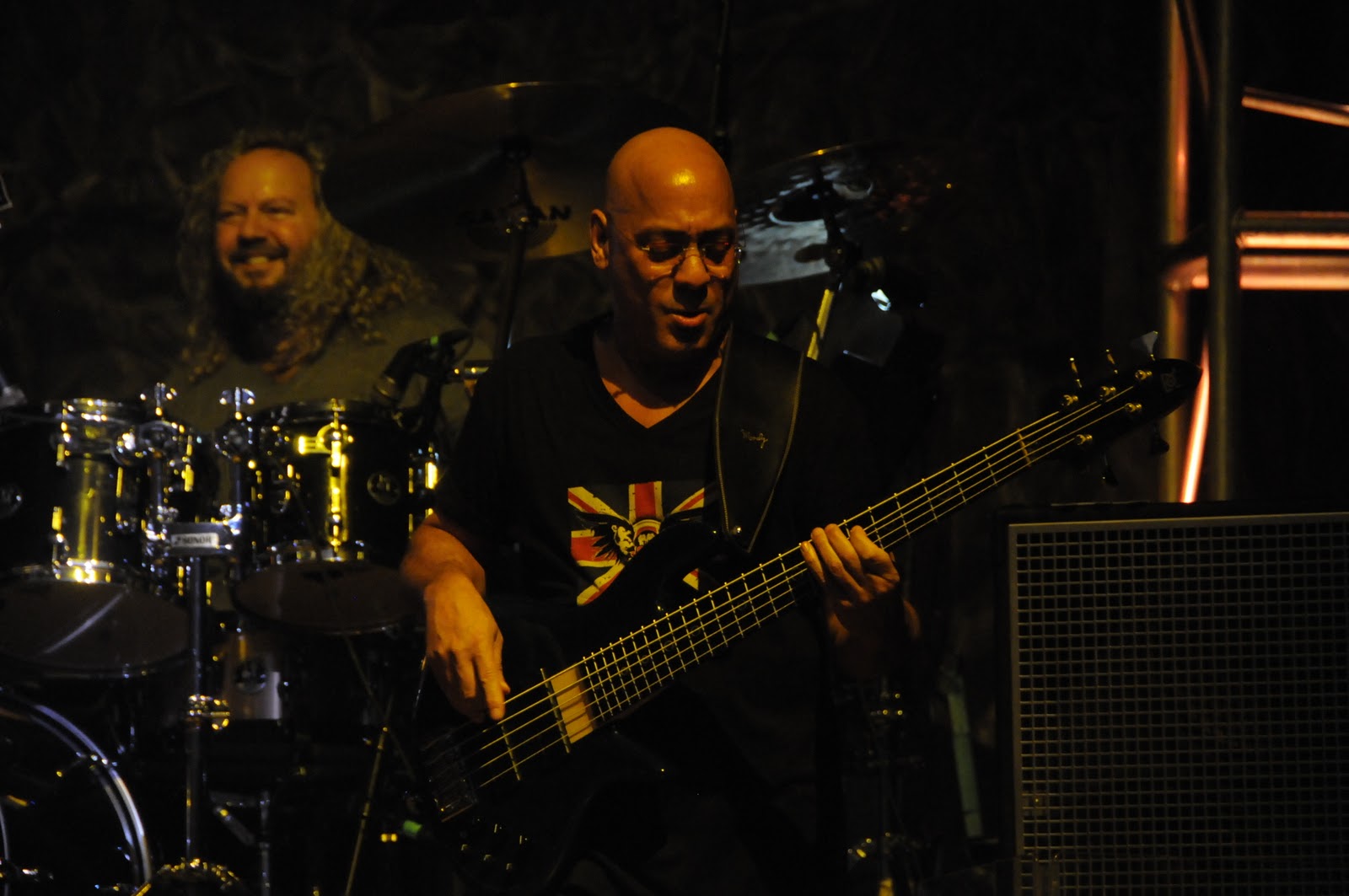
I've not yet mentioned bassist Barry Sparks, but filling the shoes of the truly legendary Pete Way is as difficult a job as there is in all of classic rock. Way co-wrote a great many of the songs being played tonight, but more importantly he had what is so very rare, a tremendous stage presence. Pete Way was a direct influence on Iron Maiden, and Def Leppard, as well as indie rockers Guided By Voices. As much as an absent guitarist can create a gaping hole, so can the band's spirited cheerleader, the life of the party itself.

Sparks is a veteran with an amazing resume, including time spent with Yngwie Malmsteen, Uli Jon Roth, Ted Nugent, Dokken, The Scorpions, and of course, the Michael Schenker Group. Not just a great player (and he is a monster of a musician), Sparks is a tremendous performer, singing every word of every song, engaging the audience constantly, and conveying the sense that there is no place better in the world than onstage with a great rock and roll band. I can think of no one better to fill Pete's shoes, and as a player, no one can argue that he's a great musician.

Someone close to the band of old suggested to me before the show that I was about to see, "....a crown without the jewels." Actually, nothing could be further from the truth of the matter. Don't get me wrong, I miss seeing Michael Schenker and Pete Way playing in UFO. Anyone who ever saw them would. But, it is by their choice that they are no longer members of UFO. UFO is still a very great rock and roll band, not a tribute, not a substitute in any sense.

Doctor, Doctor is the oldest and perhaps most beloved song of the evening, dating back to May of 1974, and the Phenomena album, the first with which UFO dented the American consciousness. Another timeless classic that the audience sings as loudly as the band, and the smiles upon the faces of everyone in the room says it all.

You can tell a UFO fan by walking up to any fifty year old rocker, and simply saying, "Misty green, and blue." If they are a fan, and they inevitably are, they will respond with, "Love to love to love you," the chorus of an epic tale of rock and roll and the road, Love To Love. Yet another complex arrangement that would leave even the most competent musicians scratching their heads, the song sees Moore switching from electric to acoustic throughout, and playing some of the best guitar of the night. The entire band is highlighted on this wonderful old gem that leaves some in the audience a bit misty themselves. Maybe that is the greatest thing about this great night - the fact that everyone appreciates. The audience loves, and appreciates the band - deeply. The band loves, and appreciates another night of glory and shared feelings. This is the truth of rock and roll. This is UFO.

Mogg has been playful with the audience and the band all evening, and especially with the aforementioned Andy Parker, who incidentally is playing as well as I've ever heard him play, bringing a carpenter's slam to every snare shot, and directing the newer kids with his expert timing, and fills. Now, Phil gives the audience a hand in song selection, asking if they'd rather hear Rock Bottom, or Lights Out.

Rock Bottom is a riff like no other. It suggests nothing that came before it, and it has not been copied, or cloned. It is as unique a riff as exists. Vinnie Moore, and the band take the audience on a twelve minute journey that is amazing to watch. It contains all the elements essential to the band, and expand on what has preceded it. Paul Raymond is once again masterfully switching instruments, and his duets with Moore are as breathtaking as they were with Schenker back in 1978. Harmony and unison lines are passed back and forth with daring, and precision. If there is a better rocker with which to end a show, I've yet to hear it.

And with the completion of Rock Bottom, it is, "Thank you, and good night."

"UFO, UFO, UFO, UFO, UFO, UFO, UFO, UFO, UFO...."

That's twice tonight that I've heard this chant, and twice that its sheer energy and exuberance have blown me away.

Once again, Mogg plays the gracious host, and offers his audience a choice. "Lights Out, or Shoot, Shoot?"

Lights Out it is, and I have to believe the crowd made the right call. The blistering pace of this number makes it the perfect encore. 'Hold on tight, until the end,' indeed, and we do, as Moore and Sparks take this one beyond the limit, and into territory both new, and exciting. These two outstanding players bring to this band a combination of extraordinary musicianship, and beautiful enthusiasm. Though many years younger than the band's founding members, better band-mates could not be found. I honestly cannot remember when I've seen a band have more fun onstage than this bunch did tonight.

To those members who I first saw back in '78, I offer this:

Phil, Andy, and Paul - I thank you fellows from my heart for a great, great many years of service, and enjoyment. For everyone in the audience tonight, I think I can say that this was a great one, a show we will always remember, a night that made us recall why we love rock and roll, why we love UFO so dearly.

Tuesday, March 22, 2011

Joe Bonamassa: Coming Into A League of His Own?

"I told Joe after the show that he was getting to the point of being in a league of his own. I told Tal Bergman the next night that I had never heard a new member change a band so much (in a wonderful way). I told Rick Melick that his Hammond cut through the way I had always wanted it to. I told Carmine Rojas that it was fantastic to hear him off his leash, and sounding like Carmine Rojas again."

These were my words, written to Joe Bonamassa super fan, Patty Patrick, after I attended two of the axe-slinger's shows over the past weekend, and I meant every word I uttered.

As individuals, the entire band took my words with humble acceptance, but all beamed at my thoughts. They know they are on fire, yet remain focused on the work, and refuse to bask in too much of their own limelight. Bassist Carmine Rojas (David Bowie, Rod Stewart, and a long list too lengthy to print) was the most animated and outspoken, saying that the addition of drummer Tal Bergman had indeed reinvigorated the band and ratcheted the sound up significantly, which incidentally, is quite an understatement.

Drummer Tal Bergman joined the Bonamassa band shortly after the departure of longtime fan favorite, Bogie Bowles late in 2010. Bergman had previously worked with Rod Stewart, as associate-producer and drummer on the platinum and Grammy nominated album (7 million world wide) It Had To Be You...The Great American Songbook. While this is certainly a wonderful accolade, it in no way prepares one for the powerhouse tub beating that Tal brings to the Bonamassa live show.

As I told Bergman, I have never seen one individual impact the sound of a band so much with their presence. His animated antics, and superb command of the drum kit takes the show up a tremendous amount in terms of energy and excitement. From his subtle underpinnings on Sloe Gin, to his astounding assault on The Who classic, Young Man Blues, the drummer prods Bonamassa and the band to heights previously only hinted at.

Going to the show, I was somewhat flummoxed by the fact that I had interviewed Carmine Rojas almost a year ago, yet had failed to produce a word publicly. However, it became apparent almost as soon as the show began why I had failed to do so. I am a huge believer in timing, and the concept that things often happen in their time, and as they should. When I saw the band later that night after I had spoken with Carmine back in May of 2010, I must admit that I was somewhat disappointed. I have been a huge Rojas fan since the Bowie days, and frankly thought he was playing beneath his capabilities. Not bad, not poorly, but also not the bass voice that had so driven Bowie's China Girl to the top of the Billboard charts (when those charts meant something). Something was amiss, but I only realized a few nights ago that the band was playing well, but not nearly up to what was possible.

Joe Bonamassa lives his life out on stages before thousands of adoring fans most evenings. Long ignored by the mainstream music press, the guitarist has slowly worked his way up to being perhaps the most powerful stage act in the world of blues and classic rock. His ascent has been both disciplined and logical. Bonamassa, and his manager/business partner, Roy Weisman, have grown their business in a very intelligent manner.  Larger stages, longer shows, better bandmates. His fans have loyally followed this growth, and have also grown hugely in number along the way. As for me, I came to the Bonamassa universe late in the game, only in the last few years, so I saw things a bit differently. Certainly as a guitarist, Joe Bonamassa has long been the king of the American blues scene, but only more recently has he catapulted his way to the top of the heap in the realm of guitar greats such as Clapton, Kossoff, Page, and Moore, the demi-gods who transcended their blues roots, gained rock credibility and became icons of the music world, transcending labels. While I agreed that Bonamassa had a great set of hands, I was not so convinced until the last year that he had achieved greatness. Now I am convinced.

Bonamassa's technical prowess has never been in question, the kid always had great chops. However, I have never seen a musician grow more in a short period of time. His playing has improved tremendously. He has found his own voice, a voice that recognizes the past, but also blazes its own path. Where before I heard many echos of players such as Jeff Beck, Eric Johnson, and others, I am now hearing a voice that is more closely identifiable as that of Joe Bonamassa. Much of this seems connected to the almost amazing leap in the guitarist's singing abilities. He himself has often stated some misgivings about his vocal abilities, but I believe this will now be a thing of the past. I must think that both the experience of watching, and listening to Black Country Communion bandmate Glenn Hughes, and the pressure of having to sing alongside the force of nature that is Hughes' voice has upped the ante considerably, and that Joe has risen to the occasion. His singing is stronger, more powerful, and more adventurous than ever before. This also translates straight to his guitar playing. His style is becoming more passionate, and more exciting. His vibrato sings with a new soul that is recognizable to any astute listener. His guitar melodies, and solos now echo the voice coming out of the man, not just the instrument.

New songs such as Dust Bowl, and Slow Train display a new side of Bonamassa that he has been heading towards for several seasons - heavy, swampy rock, filled with passionate vocalizing, and some of the most distinctive guitar soloing to be heard. This is especially true on Slow Train, in which the guitar and vocal tracks sound in league with the lyrics, and the musician producing them. The guitar solos on this tune are remarkable in conveying not just a player's prowess, but the song itself. Live, these tracks are incredibly powerful, immediately grabbing an already attentive audience by the throat, and forcibly bringing them along. You can almost here the shock in the audience as it responds to the new band's sheer force. It's a joy to hear, as traditionally, Bonamassa fans have clung to the bluesier roots as the guitarist has evolved more towards a larger and more adventurous rock posture, one that suits him perfectly. It's great to hear an audience grow alongside an act.

Guitar fans should find this tour to be maybe this year's best catch, as Bonamassa brings out some of his finest pieces, including a 1959 Gibson Les Paul, the most iconic instrument in the world of the electric guitar. This particular Les Paul, one of many Les Pauls Joe plays in the show, sounds unlike any of the others, and it becomes apparent why this axe is the grail. It sings with a purity unrivaled, a bit cleaner and leaner than the higher output Les Pauls of today, evoking the memory of Peter Green, and the Eric Clapton of the Mayall days. His tones are always impeccable, and he judiciously tosses in some great wah tones, some serious Leslie cabinet emulations, and his longstanding use of the theramin to keeps things interesting, and moving along. You never get bored by the sameness of arrangements, or sounds, the curse of many a modern blues rocker.

The band is blossoming on stage, in just the short time they have been working together. It's a joy to see musicians' heads whirling as they laugh appreciatively at great riffs, or unanticipated improvisations. Joe Bonamassa is having a seriously good time with this band. Drummer Bergman has lit a fire under these fellows, and he seems to enjoy it tremendously. The interaction between Rojas, Bergman, and keyboard player Rick Melick is constant, as Bonamassa fires off volley after volley of great guitar licks, rarely repeating himself in a show that has grown by a half an hour in the last month, simply due to the band stretching out and enjoying the jams. I saw Carmine Rojas shaking his head in appreciation at certain points in which Bonamassa sang a certain line with great soul, and conviction - this from a man who shared stages with Rod Stewart, and David Bowie for over 20 years. Also a joy is watching Bonamassa and Rojas furiously trade licks, not ever wondering or worrying that Bergman would relinquish the time, or tempo. I must also give mention to the excellent tones, and notes produced by keyboardist Rick Melick. The Australian had been noticeably under mixed in tours past, and not only is he now more audible, but he has brought along a beautiful, and powerful Hammond B-3 organ this year. I must admit to missing his harmony vocals, though. He manages to hit some of the old harmonies on his synth, but I definitely prefer him singing. The volume of the keyboards, and the addition of the B-3 largely speak to the issue of tour economics, and crew size than to any other factor. Front of the House soundman/tour manager Warren Cracknell is on board again, and doing a better job than ever as the band gets considerably louder, yet more balanced and pleasing to the ear.

I may get a bit of stick from longtime Bonamassites who have been on the Joe train for a longer period, but that's okay. I am a damned hard fellow to please as a I look at everything in a very big picture. When I compare a guitarist to the likes of Page, Moore, Kossoff and others, I mean it. You can't be close, you have to be there. I don't relax standards, ever. I have waited to write about Joe Bonamassa as a solo artist for a while, sometimes to the irritation of some, but have done so for a specific reason. I was waiting for him to become someone I could compare to the few at the top of the hill. I thought that he might, but refused to speak prematurely. I stated last year when writing about Black Country Communion that he had turned a corner, and had made tremendous progress. I was right. I have never seen a musician work more diligently, and have rarely, if ever seen such startling improvement in a brief period. Joe Bonamassa has become a maestro in his own right, and I see no end in sight. If you have hesitated in the past to give the guy a shot, now it is time to pay attention. Buy the new record, see this tour, and expect to be blown away.

Greatness is a term bandied about much too readily, and has over time become besmirched, and lost some gravitas. Joe Bonamassa has achieved greatness. He has a band that is equal to his talents, and that works as hard as he does to please, and thrill their audiences. The package is complete and has been delivered. As I stated, Joe is now approaching a league of his own. What I meant by that, Joe, is that you have climbed the mountain, and have planted your flag. There are very few guys left out there who can play great guitar, write songs, sing them passionately and with conviction, and can fill seats in the manner in which you are doing. Congratulations are in order. Your tremendous passion, and work ethic is paying off handsomely.

Thanks to all in the Bonamassa camp for their hospitality, and their time. I got to speak with the whole band, and manager Roy Weisman over the weekend, and was able to properly determine that what I had thought was true, was, in fact - that this band is as thrilled as their audience about this tour.

Photos courtesy of Libby Sokolowski. All rights reserved. Thanks to Libby for the connections, logistics, and so much more.

Sunday, February 6, 2011

Gary Moore - Rest In Peace

It's terribly difficult to put into words what I am feeling on this cold, wintery Sunday afternoon. Just this morning, I wrote a defense of Gary Moore, only to hear hours later of his death. I am, along with a great many others, shocked and saddened.

I have been a huge fan of Gary Moore's since I was about 16. I saw Moore play with Thin Lizzy, and it changed my entire musical worldview. At that age I had never witnessed anyone play with such passion, and enthusiasm. It was as if the music passed through him like electricity, as he jumped, grimaced, and writhed through the show. No mere posturing, the notes revealed a stunning amount of emotion and conviction. He never lasted long in Lizzy, as he was fueled by his desire to sing and write his own material, difficult to do in a band with Phil Lynott, but when they did unite it was always exceptional.

As a solo act, Moore rapidly became a huge star throughout most of the world. He headlined festivals throughout Europe, sold out tours of Japan, and sold millions of records. His status as one of hard rock's greatest guitarists grew, but his dissatisfaction with the music led him back to his first love, the blues. It was there that Moore finally cracked the American market, selling out arenas, and achieving platinum status.

The legend of Gary Moore is inextricably entwined with that of his much storied guitar, the Peter Green Les Paul. Moore had purchased the guitar from the Fleetwood Mac guitarist many years ago, and played it with Greeny's full blessing. Several years ago, Moore was forced to sell the Gibson to cover expenses for a tour canceled as a result of a hand injury. The sale is still a matter of considerable controversy, and the pain and frustration Moore felt about the situation was well known. He sold the guitar with the understanding (in his mind) that it would not be sold again, but the guitar is now on sale for some four times what he received. However, it was not the money that pained him, but rather what was to become of the guitar.

I had the pleasure of meeting Gary briefly at a guitar shop in Houston, Texas. I was playing a guitar, and noticed someone standing above me. I was rather shocked to realize it was Moore. He was to play a show that night, and I had tickets, but seeing him face to face with me playing guitar was not expected. He complimented my playing, saying that I had a nice touch. That comment has always meant a tremendous amount to me, and will never be forgotten. I had the pleasure of seeing Moore play on three occasions and each time came away more impressed. He gave every night all he had, and that was always more than enough. I often posed the question as to whether he was a better guitar player, or singer. He was as good a musician as I have seen. I feel honored to have been in his presence, and to have had the pleasure of seeing him work.

Several years ago I had a guitar built for me, a replica of the Peter Green Les Paul, completely due to the influence, and love of Moore's playing. It, without question, was the best guitar I ever touched, let alone owned. The guitar got stolen several years later, and I miss it to this moment. I suppose I'll not soon again see the likes of it, or Gary Moore.

The world is less one great musician today, and my thoughts and prayers go out to all who are feeling this great loss. I am not sure if it has completely sunk in, but it sure has hit me hard.

Thanks, Gary, for all that you gave us over the years. The world was made better by your presence. Rest in Peace, my friend.

Tuesday, February 1, 2011

David Lowery - The Palace Guards - 5 Stars

David Lowery has had a long and successful career as songwriter/vocalist/visionary for two well loved bands, Cracker, and Camper Van Beethoven. He's done a hell of a job at it, without question. But let's forget that for now. Act as if it never happened. Maybe just a dream we had. Let's instead focus on his debut solo album, The Palace Guards.

The Palace Guards is the second great record I've heard in 2011, and it is the best set of songs I've heard in some time. It sounds as if Lowery has shaken off the shackles of compromise, and chosen to follow the path of his own personal muse. This record sounds like a direct line to the artist's intentions; as if his will were pipelined straight onto the disc. All the considerations of record companies, band mates, and concessions to industry have been left alone, cast aside. And perhaps it may well be that all these things that get between a songwriter and his records are precisely what must be removed for an artist to reach full maturity, his full majesty.

Lest you think that this means that this is an album stripped bare, I do not mean to imply that. It is filled with tasty backing by a bunch of obviously experienced musicians who listen intently, and add their parts with great empathy and skill. The Palace Guards is a great sounding record from beginning to end, filled with subtle twists, surprising changes, and great playing throughout. There's a wealth of strange textures, unusual instrument choices, and an overall sound that harkens back to the best records coming out of Britain in the 60s. But, for all the soundscaping that goes on, Lowery's songs and voice are always the main attraction, and he's at the top of his considerable game.

The album kicks off with the title cut, a great piece of endearing pop sophistry reminiscent of the best British psychedelic/folk music. Far be it from me to tell you exactly what Lowery is getting at lyrically on this album, but if I were guessing, I'd say that at 50 he's looking upon not just himself, but the world at large and coming away disappointed, yet hopeful. He seems to have his teeth bared, but with a healthy dose of sympathy, and understanding. The Palace Guards are revealed as somewhat malevolent, but perhaps that was not their intention - maybe the responsibility of making all the decisions for so long just slowly, and imperceptibly corrupted them. Sonically, this one is pure ear candy, driven by Lowery's always excellent acoustic guitar work. Take notice incipient band leaders: it all starts with a solid accompaniment, and Lowery has long been a master. There are a bunch of great sounds, and an abundance of great playing going on, but it all serves the song, and decorates Lowery's words and guitar with taste and distinction.

Raise 'Em Up On Honey is a rollicking, toe-tapper of a hoedown, kicked off by a nice melodic harmonica that is joined by a subtle banjo, before some gorgeous pedal steel guitar rings in the first verse. This is Lowery singing in his best everyman twang, a voice that is friendly, familiar, and trustworthy. Lyrically, this one serves as a wonderful description of the plans brought on by the disgruntlement that drives both the green lifers, and the militant militias back up into the mountains. Coming in the footsteps of the title track's beautiful pop tapestry, it is amazing that this jump to Appalachian folk should be so easy to swallow, but this bunch makes it sound completely natural.

Deep Oblivion is well worth whatever the cost of this album may be. This song reminds me of the Hindu story of the husband of Maitreyi, who at a certain age, tells his wife, "I have decided that I have had enough of this world. Everything that we have, I will give it to you and I am going into the forest to find myself." Then, Maitreyi, his wife asks, "What makes you feel that I will settle for mundane things? When you go for the real treasure, what makes you think I will go for the petty things? Will I settle for trinkets?" They then both go to the forest, and live as realized beings. If Lowery goes into the wilderness, he's not going alone. It's a family affair.

Poetically, Lowery seems again to be considering stepping away from his world while simultaneously weighing the risks. Musically, this is a great travelogue. Why do rockers make such better use of steel guitars than do their country counterpoints? This has me thinking back to George Harrison's All Things Must Pass and Lennon's Mind Games, both so filled with mental musings and beautiful sounds. The sound of this track will have you hitting repeat to absorb Lowery's lyrical travails. Gorgeous.

The next track, Ah, You Left Me, has Lowery covering a song that sounds as if it were written by a fan of Lowery's. Yet another tasty dollop of production wizardry - this one is cinematic in its tones and textures. A great stew of guitar tracks; from haunting arpeggios, lilting tremolo pads, to a deliciously double tracked guitar solo. If there were still real hit singles, this would be one.

Rock and roll rears its ugly head, loudly and proudly on the droll Baby, All Those Girls, a tongue in cheek confession that has been intoned by many a guilty road rocker. This is a, "Just a way to pass the days until I return to you, done you wrong, love song." By far the record's rockingest cut, filled with chainsaw rhythm guitars and cool synth underpinnings.

I Sold the Arabs the Moon has Lowery wondering what you do after you've sold everyone everything they desired. It is a  despotic view reflecting upon what's come before, and what it may all mean. Laconic violins accompany the storyteller with great sympathy, disarming any sense that perhaps it all meant nothing at all.

David Lowery plays Houdini on the next track, Marigold. Out of whole cloth he creates a song that's not really there - a dream, or an imagining - or perhaps they are just a bunch of lines that sound good when sang, at least he'd like to have you think that. I think that once again this has Lowery singing (unconsciously?) about his journeys through his past, those that lead an artist to finally going it alone. Looking back over travels, tales, hits, and misses, maybe in a few years this one will be easier to comprehend. Or, maybe it is just that - a bunch of lines that sound good when sung....another beautiful track at any rate. If it means this, that, or nothing at all, it sounds wonderful.

This album features some of the most organic, well placed keyboards that I have heard since the days of Garth Hudson, and the track Big Life has them in spades. The introduction is a minute of sonic bliss, with a compelling melody being driven by a very Keltner-esque drum track that propels the tune perfectly. If you don't know who Jim Keltner is, then it's time you Googled him and got schooled - he may be the best session drummer ever. But, I digress. This whole record has me going back and forth, one moment focusing on the great musical arrangements, then being reeled back in by Lowery's engaging vocals and words. A fun record to listen to, and get lost in. "It worked out alright, 'cause it's a Big Life."

David Lowery doesn't want you to know just how autobiographical this record is, hell, he may not even realize it himself. He reminds me of my old friend Robert Pollard, another master of obfuscation, and melody. They are two of the best songwriters of the last half century, and it pains them both considerably, it would seem, to consider this notion. However, this fact is immutable - David Lowery has made the best record of his career, and he did it under his own power.

Submarine closes out the album beautifully. This is another tale that could be interpreted as this or that, or maybe nothing, but I'm guessing it's as straight ahead a love song as we'll get. I may well be wrong, but this whole record sounds like a very well written if somewhat disguised love letter, wrapped in some historical and political dissatisfaction. Lowery may be a little pissed, a little disgruntled, and somewhat belligerent, but he can't hide a root optimism, and love of his life and art. If nothing more, he's made an incredibly listenable disc that will spend a lot of time in your player. Like I said, it's the second great album I've heard this year, which gives me some much needed optimism as well, so thanks, Dave.

This is another record that you should buy - spend your money on - pay the artist. Most new music is free because that is what it is worth. This is a piece of cool art, created by a working artist. The world needs to support the good stuff, and here you vote with your dollars. Sorry to go on, but I feel that when someone does something that pleases you, you owe it to them to respond appropriately, and in this case it means buying the artist's art.

For some great background and good reading, check out David Lowery's excellent blog:

http://300songs.com

Friday, January 21, 2011

Lars Haavard Haugen - The Truth and Six Strings - the interview on the album

"You know, Tony, that's it. We spend all those years playing, to finally be ourselves."

And so it is, was, and always shall be. The humble words of any great musician who has accomplished the ages old task of discovering, learning, and mastering their trade to becoming not what, but who they are. There are no shortcuts to musical greatness, and Lars Haavard Haugen has taken all the steps necessary, and has achieved said greatness. This is reflected in his many years, and records with Norway's Hellbillies, and never more so than on his first solo outing, Six Strings and The Truth.

You most likely do not yet know Lars, or his work if you are an American reader. If you're reading this in Norway, you've probably been enjoying Haugen's work since the early nineties. On January 31st, Six Strings and The Truth will be released by EMI Norway, and hopefully available to American listeners via iTunes. Here is the official video of Landscapes, the album's first single:


I spoke with Lars yesterday at some length about a great many topics, but we started with his new record.

Lars Haavard Haugen, "I have been thinking about this for many years, to record a solo guitar record. I worked on my writing and playing for a long time, and finally felt that it was time. I began recording this in January of 2007, and worked on it between tours, records, and my other work as a producer and session player."

It was a little surprising to hear that the record was tracked over a three year period, as it sounds so coherent, and spontaneous that it could have been tracked in a month. While the range of styles and technical skills involved are tremendous, the record is an amazingly easy and enjoyable listen. Haugen had this to say about the process:

"That is probably due to the fact that we recorded it in my studio, using basically the same equipment throughout, the same rhythm section, and mostly the great engineering of my partner at the studio, Lars ( he laughs, and doesn't give a last name, and I forget to ask). Lars handles all the technical end so as that I can focus on writing, and playing the guitar.

"We cut the record mostly live, though I did on several tracks record the guitar separately, mostly to utilize our large room, and play very loudly, utilizing various microphones and techniques. Sometimes, on tracks such as The Drone, I played in the control room, and recorded the amps in our room to capture a huge sound."

One listen to The Drone and you will instantly hear what Haugen is saying. Utilizing a Jerry Jones twin necked 6 string/baritone, the opening of this tune is as big a sound as I've ever heard captured, as if Haugen had channeled John Entwistle's huge bass tone, and combined it with his own unique guitar voice that evokes everything from Brett Mason to Jimmy Page, but always manages to sound like Lars. The man has his own unique presence, quite apart from his influences.

"Back in the seventies, my brother returned home from studying in America, and he brought with him many American albums. I was taken by the Dixie Dregs. They greatly influenced my playing (I was in my teens at the time), and the way they changed directions within tunes really stuck with me. I have tried to incorporate that into my work. I like to keep things interesting for myself, and the listeners."

Haugen also mentioned Albert Lee, Brett Mason, and some other seminal pickers as early influences. Certainly their influence made an impression on not just Haugen's playing but also on Lars' guitar choices:

"I recorded a great deal of the album with my Tom Anderson Hollow-T. I really like its big, full tone, but it still retains great Tele tones."

For those unfamiliar with the Tom Anderson Guitar Works magic, here's a few words from the maker:

"To be able to consistently deliver this mystical tone, Tom Anderson Guitarworks created the Hollow T Classic. The hollow chambered body nurtures a healthy fullness without giving up the twang factor. In their July 1993 issue, Guitar Player Magazine conducted a monumental guitar test. They called it “Tele Visions.” The banner on the cover of the magazine read “Shootout! 32 Telecasters & Tele Copies Rated.” They compared 32 “Tele”-style guitars from all different manufacturers. The winner was the Tom Anderson, Hollow T Classic. They concluded their write up of the Hollow T Classic by stating, “In our humble estimation, it just doesn't get any better than this”—very nice of them to say so," Tom Anderson Guitar Works.

Haugen adds, "I also used my PRS David Grissom model which I enjoy playing a great deal, a Collings L-35 that I used on parts of The Drone, and the Jerry Jones double neck with the baritone neck on the bottom, and six string on top."

I commented on the tremendous, dulcet tones on the re-recording of an earlier Hellbillies title track, Urban Twang, asking Lars which guitar he used for the lovely Bigsby sounding trem work. He looked at me with some surprise and laughed quite heartily. Then he spoke:

"Ha, there is no tremolo bar on the album at all! All the bends are just bends as I played them," He said with a rather large grin, "I am a big fan of Albert Lee, and especially of Jerry Donahue, do you know of him?"

Then it was my turn to laugh. Jerry Donahue pops into my life from time to time, I have worked with Jerry on several occasions, and he is a dear friend of my editor, and of course, I have enjoyed his playing since his days with Fotheringay, and Fairport Convention. If I'm not mistaken, I think I also consulted on some early beta testing of the Whirlwind JD-1 preamp pedal that Donahue designed.

Lars continues, "All of the notes are my bendings. I love pedal steel, which I play some, and have always sought to emulate, and integrate pedal steel bends into my regular guitar work. It adds to the expression."

Urban Twang (Slight Return), is destined to become this year's big guitar instrumental track. Classic in the same sense as Cliff's of Dover, Surfing With The Alien, and dare I say, the Santos and Johnny classic, Sleep Walk. Yes, it is that good. Its melody, poignant, and heartfelt will remain with you - expect to be humming its refrain for some time.

I first became familiar with Lars through his relationship with 65 Amps.  He had attended an amp unveiling party just prior to NAMM ( a few months, actually), and their attention towards him garnered my interest. I asked him about how he discovered 65 Amps:

Lars, "I was introduced to 65 Amps by their Norwegian dealer, VINTAGE GITAR. I believe I bought the first of their amps in all of Europe, a Marquis model (no longer in production). It was simply the best amp I had heard. I have owned and played many amps, Dr Z, Matchless, Big Cat, and they are all great amplifiers, Tony, but the 65s, they just have something extra, that smack. It's hard to explain, but it sounds the best, just brilliant.

"Then, I came to America with this dealer, and I had the opportunity to go to the NAMM show, where I met Dan Boul, Peter Stroud, and Myles Rose, all very great guys. So, for a long time I was using the Marquis, and the Royal Albert as my main stage amps, always in tandem. They offer very different sounds that when combined make a huge tone.

"But now, I have changed my live rig over to a Monterey 22 watt model, and a Tupelo 20 watt. This is to reduce my stage volume which had become just too loud. The Monterey is very warm, and has great bottom, and the Tupelo is brighter. I have had to adjust to having less headroom due to the lower wattage, but they sound fantastic together."

 I asked Lars if he used the 65 Amps Monterey on one setting, or employed its channel switching capabilities?

Haugen says, "No, I use the channel switching. Unusual, because this is difficult for many amplifiers, but with 65s it works very well. They sound great."

Actually, 65 Amps don't employ conventional channel switching, but rather they employ their unique proprietary Bump technology - from 65 Amps website:

"The Monterey is designed with the purpose of delivering classic American amp tones with a greatly enhanced vocabulary that extends across the Atlantic to Britain. The Monterey can go from classic warm and hot American tones to a wide palette of modern, rich boutique distortions at the flip of a switch.

"All of this is done without the normal sacrifices that one associates with classic American amps. The bass response stays tight and composed throughout the tonal spectrum of the amp. Distortion is robust, complex and unhampered by the normal shortcomings of traditional circuits. This means: no flabby low-end, no shrill top-end; a pleasant, detailed rendition of your favorite 6V6 vocabulary with many new voices, American and British, added.

"The Monterey employs our trademarked Bump™ control. The Bump™ control is a much more effective alternative to traditional channel switching. The Bump™ allows the user to both gain-up and re-slope the amp's tone stack allowing much more midrange to flow through the circuit; thereby gaining up the entire amp naturally and not inducing false preamp gain that creates fizz and buzz. The end result is the effect of having two amps in one."

Lars goes on to talk about his equipment, "I always use my Voodoo Labs Sparkle Drive, the green Line 6 delay pedal (DL-4), two compressors - a Keeley Classic Compressor that I use for single coil guitars, and a Diamond Compressor for humbuckers. The compression is always in line, I use it almost always. Compression for me removes the harshness, and smooths out my tone, while giving some extra push. Thank you for noticing it, it is a big part of my sound!

"I used an Empress Tremolo pedal on the track Closing Time, I like its sound, and it has a tap feature that I really like having available to me to use whenever I like!"

Haugen plans on playing some festivals, and shows around Europe throughout 2011 to promote Six Strings and The Truth before he reconvenes with his regular band of the last few decades, Hellbillies, a Grammy winning act in their home country of Norway.

Hopefully, Six Strings and The Truth will awaken American audiences to the talents of Lars Haavard Haugen. He has succeeded in recording a truly great guitar instrumental record, and that is a mighty feat. So often, guitar records are the result of a player's ego, as opposed to a result of their creative gift. Haugen has proven the exception, and produced a record for the listener, one that will stand up to repeated listening and may be destined to become a guitar instrumental classic.


Lars Haavard Haugen is a great guitarist, of this there is no question. His playing is tasteful, chops laden, and his tones are superb. He also has developed great compositional skills, and his songs are just that - not just frames on which to hang a thousand cool licks (which he does have), but memorable tunes that are full of great imagery, and emotion. As I said in my earlier review of Six Strings and The Truth, you should hear this record not for Lars' sake, or because I said so, but rather because as a listener and lover of music - You Deserve To Hear Music This Cool!

Thanks to Lars Haavard for his generosity and time, to Libby for her expert editing, and to all my friends who may happen upon this. Namaste.

Sunday, January 16, 2011

Hayes Amplification - Perfecting Pure Guitar Tone, One Amp at a Time

"I have seen many Fender Tolex amps over my time working with amps, and the work by David Hayes is arguably the best I have seen." - Myles Rose, from The World's Best Amps

David Hayes? Myles Rose? You may ask, just who are these fellows?

Myles Rose may well be America's guitar amplifier guru, having served many years at Groove Tubes as a designer, head tech, product development specialist, as well as being the co-author and technical editor of the Groove Tube Amp Book. After this distinguished service, Myles became a consultant to such amp builders as Dr. Z, 65 Amps, and many others. Mr. Rose is also the moderator for Guitar Player Magazine's online technical forum, Ask Myles Rose. When not running his current company, Guitar Amplifier Blueprinting, Myles can be found almost daily feeding homeless families in Los Angeles, and blogging eloquently about their plight.

David Hayes happens to be one of Myles's favorite amp builders. When asked about David's work, Myles says, "I try to avoid talking about David too much, because once the subject is on the table it is hard to stop. I could talk for 30 minutes on his construction alone."


Myles continued to say, "His work on restoration is not restoration at all, he takes things to the next level. Think of the Petersen Automotive Museum, where you see cars from decades ago in conditions exceeding that which they were in when they were originally driven out of the factory. David's Fender-style amps are always way above what was factory produced.

"I thought it was great when David started a slant on his own take on the classic amp circuits adding his own twist to things. All the magic of the past with a lot of new magic that fits into the total picture."

I take great pleasure in owning one of David Hayes's amplifiers, a creation he calls the BF-5E3. I call it, my Little Red Corvette.

David's designation perfectly describes the amp head. It is basically a cloned, updated circuit of a 50s era Fender Tweed Deluxe with the power of a newer blackface Fender Deluxe. It encapsulates all of the tones found in the amps used by such luminaries as Keith Richards, Ronnie Wood, Neil Young, and Billy Gibbons on so many great rock records, but adds the horsepower necessary to drive a band on a loud stage. David says this amp probably is pushing 30-40 watts when peaking. I will add that it is a very loud 40 watts.

I have already discovered that within this gorgeous red Tolex cabinet several brilliant single channel amps reside. I started off using the amp as shipped, with a NOS Philips 5U4 rectifier tube. This produced the tone of the gods, a corpulent and clear voice that sagged wonderfully, producing tones that, depending on which guitar I used, would range from a very Stonesy rhythm tone with a Fender guitar, to a picture perfect ZZ Top grind when I utilized my Les Paul.

This amp made me realize that I had to play up to its expectations, and not the other way around. Most generally, a player will play through an amplifier and try to coax the sound in his head to come out of the speakers. Not so much with the Hayes. It instantly made me try to play as well as the amp sounded. The tones were exactly what you visualize in your mind's eye, and it simply asked that the player play. This amp is an instrument in its own right, as much as any guitar.


Amazingly responsive, the BF-5E3 is brutally powerful, yet when the volume is backed off on the guitar, it cleans up beautifully and becomes a sophisticated blend of shimmering highs and warm lows. I found that the amp was brilliantly intuitive, almost as if it was getting to know my playing, and responding like a lover more than a machine. Then I had the misfortune that will sometimes befall everyone who seeks prime tone. The amp's 50 year old NOS rectifier tube gave up the ghost. Yes, sometimes when a New Old Stock tube is used it will simply fail. This tube died of a bit of dryness that caused a crack in the plastic housing on its underside. Simply a tragedy of time, no reflection on the tube's capabilities, just old age. I could not find a suitable replacement as quickly as I would have liked, so I opted for what was available, a very desirable high end GZ34 replacement rectifier tube. Rectifier tubes are notorious for having the ability to completely change the sound, feel, and response of an amplifier, and never more so than when the amp is top notch.

Incidentally, when I removed the rear panels to replace the tube, I was astounded by the neatness, and the beauty of the amp's interior. I have never seen more artful work, nor careful attention to detail. The beautiful point to point wiring, and the careful braids that had been tied were not only precise, they were also gorgeous.

Lo and behold, with the installation of the new tube, a new amp was born. Where previously I was engrossed by tones that harkened back to the vacuum tube glory of the halcyon days of Leo Fender, I was now thrown into the realm of the ultimate Bluesbreaker, Eric Clapton. The wonderful sag of the 5U4 had been replaced by a tone that jumped out of the amp with belligerence and a significant increase in midrange wail. Much closer to Jim Marshall's original update of an old Fender Bassman, the Little Red Corvette was now one of Big Daddy Roth's hot rod creations.

The amp still retained the ability to clean up when the guitar volume was reduced, still maintained the subtle nuances of the player's right hand, and still asked me gently and kindly to be a better musician. And, it is unquestionably loud enough to be a commanding voice on any stage short of Metallica's. While it is loud, beefy, and forceful, it probably wouldn't be fair game in the metal realm, but for any other style of rock, blues, country, or jazz - I cannot imagine a more toneful amplifier.

Myles says of Hayes's builds, "His one off pieces are works of art, and use top notch components, and an attention to detail of workmanship that is second to none."

I asked David Hayes about this amp's history, and he replied, "The BF-5E3, funny story. I had a 5e3 chassis but no tweed transformers and it was one of those days when I was in between builds and bored. Well I just happened to have a full set of Blackface Tone Clone Mercury Magnetic transformers and I said if the power tranny will fit, I can make the rest fit. It did, and so I started building to pass time and occupy myself. I figured the blackface transformers would be too powerful for the standard 5E3 circuit, so I made some upgrades right away. First I installed over-sized filter caps and upgraded the values of some of the resistors and caps. I had no idea what the amp would sound like or if it would even work, but when it was done I brought it up on the Variac and plugged it into my 1964 2X15 Fender Bandmaster cab and it blew me away. I could not believe how it sounded. I then hooked it to the 2 JBL D-120F speakers in my Fender Twin Reverb restoration and made a little video. Myles saw and heard this, e-mailed me, and said that to him this amp was the iconic example of true tube amplifier tone and that I should make a CD of this tone and sell it. That was all I needed to hear because Myles is to me the best tube amp guy on the planet."

David Hayes is a fiercely devoted man. He is relentless in his pursuit of guitar tone, and his desire is to build the best amps possible, one at a time - strictly to bring out the best in the music.

"I try to use the best quality parts that are available, such as transformers, resistors, and capacitors, and I am in this for the music and the guitar player more than I am for the money," said David Hayes.

When asked why his name was relatively unknown, and unseen on the pages of the industries many great publications, David had this to say:

"As for how I remain out of the pages of magazines, I turn down offers of free advertising and interviews, which is also why I haven't become a factory type builder, mostly because I want to stay small enough that I don't have to have anyone else building my amps like so many other amp companies. You see I care more about my amps being "My" amps so I can control fully each and every build and kinda choose who I build for and try to make the amp fit the player. I care more about music, tone and quality than I do money!"

David built two BF-5E3s. I have one, and he kept the other. I have heard a great many single channel amps over the years, and can honestly say that this amp sounds better than any other I have heard. David's words are not marketing rhetoric, they are his heartfelt mantra.

Not knowing the Hayes story, I asked David how he came to be an amp builder/restoration specialist. The tale he tells is straight Hayes - classic, rustically elegant, and to the point.

"How I became a builder? I have always been a repair guy - from a very early age I was fixing clocks, radios, TV sets and a lot of other things. In my teens it was cars, amplifiers, and most anything - then in 2004 I started buying old amps and rebuilding and restoring them to sell on eBay, and soon the word spread around middle Georgia that there was a guy that could repair tube amps, and I hooked up with a few local music stores. Well, my friends and customers said my work was second to none and I should do this full time, but I had no confidence in myself and was working in a junkyard doing mechanic work, welding and driving a big wrecker. This was a job to make up for the pitiful V.A. benefits that I was trying to live off of, as I am a disabled Veteran. One day my wife Jennifer said, "You need to quit that junkyard and stay home and do your amps." I told her I didn't think there were enough broken amps around to make ends meet that way, and she said, "Then build your own - all of your friends say that the amps you restore sound better than anything out there. I have a good job. We will be OK, and I believe in you." So, I picked the name Tube Master, dedicated my favorite amp to my wife by naming it the Hayes Tube Master "LIL JENNY," and said goodbye to the junkyard. Long answer, but this is what happened !"

Hayes Amplification is a small company, dedicated to one thing only - building great amps, one at a time. In addition to his classic remakes, and updates on legendary Fender amps, David also has built a series of Hayes Plexi's, including a recent delivery to one of rock and roll's greatest guitarists, Steve "The Deacon" Hunter. Hunter is, of course, the guitar star who played the lead licks on Aerosmith's Train Kept a Rollin', and wrote and recorded the classic intro to Lou Reed's Sweet Jane, with his cohort Dick Wagner

I asked Steve Hunter about his Hayes Amps, and he took time out of his busy schedule to tell me this, "The first thing you'll notice about Dave's amps is the workmanship, especially if you get to peek inside the chassis. It's a work of art. But, no matter how pretty things look on the inside, the amp still has to sound great. And Dave's amps do. They just plain sound great. Warm rich tone without ever being too harsh which is precisely the type of sound I always look for. Not excessively loud but they always manage to hold their own in just about any situation. Excellent with pedals. A true tube amp in every way, that will respond to your playing."

David speaks on the Plexi, and Hunter, "The Hayes Plexi came out because I had repaired a lot of Marshall amps and heard so many people say they wished they could find a Plexi like the first ones made, so I took what Jim Marshall did, and added a little more Leo Fender to it with the outside of the chassis, filter caps, and a cap pan like the Fender amps have, and added a little Hayes in the mix.

"I actually met Steve on Facebook. He liked my amps right away, we became friends and talked quite a bit about amps and music. At first I didn't make the connection that this was actually The Steve Hunter, "The Deacon of Rock & Roll," and one of my heroes on guitar that played with Alice Cooper. He had been one of the people that I considered a guitar god since I was 17 going on 18. I loved the song Eighteen, so this was like a dream come true, and such an honor to be doing anything with this man (who is one of the most humble, down to earth, nicest people I have ever met in my life).  Now, Steve has two Hayes amps - the Plexi, and the first "Purple Hayes," which is an amp that was built just to please my friends, who had said that with my name I just had to build an amp and name it that. I took my Tube Master "LIL JENNY" head with a 2X12 cab that was designed for Joey Thigpen, which is called the Hayes Tube Master LIL JENNY JT212. Anyway, I took this amp and made some changes in it to give it a little more growl, a little more punch, and a quicker breakup so it would be more aggressive and fit the name Purple Hayes!"

When I said that David is devoted, that is exactly what I meant. Sadly, several years ago, the real "Lil Jenny," was felled by a massive stroke, and David has added the job of full time caretaker to his resume. In addition to his work load of amp building, repairing, and restoration, he cares for his wife in every sense, and her recovery is always his first priority. That may be why Myles Rose had this to say:

"David - you are a great "amp" guy. I don't think anybody that has seen your work or played your amps could not easily see that and hear that with their own eyes and ears. What might be missed by some by casual observation is what a great person you are as well."

Even in speaking with Patrick Selfridge at Mercury Magnetics (the makers of the best guitar amp transformers on the planet), what was said about David Hayes was half amp worship, and half praise for the man, and probably a good place to wrap this up.

Patrick Selfridge said, "David Hayes is building some amazing amps. He is not building simple vintage clones like so many builders, but instead is making amps with his signature tone. David really sweats all the details, and it shows with the end result every time. We here at Mercury Magnetics are very proud to be a part of helping David shape his tone amp by amp. Most of all, we are proud to be associated with a great person on top of it all!"

It would be unwise of me to not thank David for allowing me to write about his work, as it would be to not write about what is the best amplifier I have ever played, let alone owned, The Hayes Amplification BF-5E3, my Little Red Corvette.

Wednesday, January 5, 2011

Lars Haugen - Six Strings and The Truth

Lars Harvaard Haugen might be the most recorded, and best guitarist you've never heard of. Hell, I had never heard of the man, and I like to think of myself as rather well informed on such issues. His first solo album, Six Strings and The Truth, may help to rectify this situation.

Six Strings and The Truth is the rarest of records, a guitar based instrumental album that doesn't have you running away in tedious boredom at any point. In fact, it makes you rather glad that his brother Aslag, the lead singer of Lars's day job of the last twenty years, Norway's country rock legends Hellbillies, chose to take some time off.

Hellbillies. Why haven't we heard of them? Well, the main reason is that the fellas sing in the dialect of the Hallingdal region of their home in Norway. Funnily enough, if you take one listen (and you will) to any song by Hellbillies, I believe you'll know what the song is about, the band being just that good at conveying emotions, and meanings via melody. They put me in mind of Tom Petty and The Heartbreakers, or maybe The Band - they are that good. They suffer no comparisons - I'm guessing they are The Eagles of Norway. Aslag Haugen has a beautiful and telling voice, and Lars is as a good a right hand man/guitar star as has ever picked up the instrument. Don't listen to me though, go straight to YouTube and fire up any Hellbillies track and you'll be a convert, a fan.

This album leads me to believe that every guitarist who thinks he would like to record an instrumental solo album should first make a dozen long players with a vocal band. From beginning to end, Six Strings and The Truth is filled with not riffs, but rather songs. Every track is a soundscape that will have you conjuring up images in your own mind.

Filled with somewhat familiar tones, and sounds, Lars's first outing as a solo act will have you reigned in with a great combination of familiarity and uniqueness. Kind of like reminiscing with a stranger. Haugen plays with a wonderfully relaxed passion that keeps you on the edge of your seat without hearing the anxiety that most instrumental guitarists display. He's not saying, "Please love me," but rather, "Don't you love this?"

Before I get into the tracks I have to mention some gear issues. Haugen came to my attention this summer through connections with two of the absolute best instrument builders in the world. Dan Boul whose 65 Amps power Lars's tones, and Michael DeTemple,and his amazing guitars, which I believe are also utilized. You'll see 65 Amps displayed proudly in Hellbillies newest videos such as Denne Red. I'm not certain which guitars, and other instruments Lars is playing here, but he seemingly has a penchant for Paul Reed Smiths, Les Pauls, and other classic guitar styles. His tones are immaculate, and always very well chosen. He covers a tremendous amount of territory across the record, stylistically speaking, and always chooses the appropriate tones, avoiding another misstep that entraps so many instrumental guitar records.

A Walk in the Park starts things off, and it moves at a brisk pace that draws you in, and will have you toe tapping and wishing that Eric Johnson's records were this song oriented. Eric is brilliant, we all know that, but he often loses listens with his sheer technicality and sophistry. This is more accessible, and I use Mr. Johnson as a point of reference, not in any disparaging sense. The rhythm section percolates solidly behind Haugen as he calmly takes us on a brilliant tour of his chops, and musicality. If there were still real rock radio, this would be this year's guitar instrumental hit single. He plays so damned well that you almost don't notice his dizzying technical skills - the ending will have every guitar player scrambling to the woodshed. It is an instant classic.

Next up is a jazzier outing entitled, How Low Can You Go, a loping trot that takes some fusion down to Texas. This features some powerful clean chording, and he uncoils chorus after chorus of cool licks and riffs, making great use of some wonderfully sophisticated turnarounds. This one, while not as immediate as the opener, will certainly grow on you as you realize how cool the playing is, and the way in which he revoices and conceptualizes the main theme throughout the song.

Urban Twang retraces some steps, being the title track to Hellbillies 2001 album. I initially wondered why Haugen had chosen to go back over the past, but quickly realized that a decade later, he has taken the song to a new level of emotional immediacy. Its poignant and bittersweet melody evokes an instant memory of a love, perhaps lost, and not soon to return. There is a militaristic, and funereal bent that brings to mind a million lost soldiers and their loved ones. That is certainly just my take on the beautiful melody, but is that not the point of a piece of instrumental music, to take the listener on an emotional journey? Too many musicians have forgotten this in the race for chops supremacy, but Haugen reminds me that music is made to move the listener. His notes and melodies pop out so sweetly that a tear comes to my eye. Midway through the tune the mood changes to a more uplifting and positive forward movement, maybe remembering the good times of the past before he returns to state his eloquent case again at the end. Lars puts on a twang bar display on this one that is on par with Jeff Beck's, and I don't mention this cavalierly or casually, but with studied respect, and awe. This is magisterially majestic - a masterpiece.

If an American guitarist had recorded the title track, Six Strings and The Truth may have been called maybe Three Yards and a Cloud of Dust. This hard charging number gets to the goal line after pulling out every trick in the coach's repertoire. Telecaster masters such as Bill Kirchen, and Redd Volkaert come to mind, as Haugen pays tribute to the art of American roots guitar playing, before going into a bolero of jazz/rock pop - how's that for genre bending? Well, that's as best as I can describe it using the tools at my disposal. It has great chops, great tones, and stunning musicality. He even conjures a little early Rush in towards the end before driving out of town in his hot rod Lincoln. Another mind-bender.

Rock rears its head proudly, and loudly on The Drone. This one will put the educated ear on a path that has King's X being dragged from Nashville to Austin, before Haugen uncorks the best bit of psychedelic guitar that you might hear in 2011. He starts of with some backward sounding licks, and then proceeds to stake his claim on turf that is more familiar to Sweden's Johan Dahlstrom (guitarist and visionary of The First Band From Outer Space). Lars has obviously digested tremendous chunks of the history of the electric guitar, and has remade them into his own. Never does he sound like an imitation, or follower - he is his own man at all times.

Haugen pulls out the acoustic weaponry for All Alone, and again he has mastered the ground he chooses to cover. This tune is wistful, and dreamy. Filled with great imagery, and melodic invention, he treads carefully between composer, and guitar star. Technical wizardry is on display in spades, but never at the expense of the song.

Speaking of songs, Landscapes comes in sounding the most of any track here like his band Hellbillies. I can literally imagine what brother Aslag would be singing over this Haugen composition. Hellbillies tunes are always melodic, and well thought out, and this is no different save for Lars filling more space with his tasteful, and lyrical chops.

Knuckle-busting chops are all over Pick It Up!, in which the Nashville sound is everywhere, displaying that Haugen could have made millions doing session work in Tennesee. The cleanliness of the tone and the picking will have you scratching your head, and maybe wondering why some of us bother. Actually, Lars makes it sound so easy that maybe if we all work real hard....

Heavy tremolo is saved for the end, and I'm guessing it is born of a 65 Amp, as Lars Harvaard Haugen rings out his first full length solo album with another example of why I feel he is one of the best guitar players most of us have not previously heard of. Beautiful motifs jump in an out of this one, at a stunning rate, and it is evident that in the twenty years that Hellbillies have been producing hits in their native Norway, Mr. Haugen was thinking about maybe making himself a record.

So there it is. This is going to be a very hard record to beat for 2011, whether instrumental or vocal. I am rather given to raving about what I like, and I make no apologies. I am not a critic - I am a fan, and a friend. I do not write about that that I do not love, but damn, I do love this record and would all but beg you to buy a copy. Not for Lars, not for me, but rather for you. You deserve to hear music this good.

I will try to follow this up with an article on the gear Lars used for the record, and his thoughts on its making, but I feel a certain sense of urgency in getting the word out about this, the first great record I have heard in 2011.

Great thanks, and congratulations to Lars Harvaard Haugen,