Showing posts with label steve hackett. Show all posts

Wednesday, October 31, 2012

Steve Hackett - Genesis Revisited II: Looking Backwards Boldly


With Genesis Revisited II, Steve Hackett has finally succeeded at a game that many have attempted of late, but have sadly failed. In an age in which many acts are re-recording old hits and albums, most generally for reasons financial, Hackett has went boldly into his past for reasons more artistic than commercial, and he's done a rather fantastic job.

First things first, let's deal with the absence of two huge voices - Peter Gabriel and Phil Collins won't be topped, that's both accepted and easy to admit. Hackett addresses this by using a variety of vocalists - some are more successful than others, but none fail in their mission, which speaks volumes. No one sounds tired, or like a pale imitation of themselves, a factor which has haunted almost every revisitation I've heard previously.


Musically, that's where this beast shines so mightily. Hackett has remained true to intents, but he has not sought to create note for note renditions. He also should be awarded huge points for spending the time, energy. money, and resources to make this sound fantastically good. He's grown as a guitarist, and as a musician, and he hits things head on and with tremendous gusto. Roger King, who is Hackett's musical majordomo is a vastly underrated resource. His playing, arranging, and recording are superb. Gary O'Toole's drum work is stellar, and always sits perfectly in these awesome mixes.

Steve Hackett is truly one of our finest musicians - by that, I mean on the planet, in this century, or any other. His solo work is regularly of remarkably high quality, and every project he gets himself into (such as last summer's Squakett record with Yes-man Chris Squire) is generally excellent. This may be his best moment for some time - I'm still trying to wrap my mind around how great this record sounds. He made all the right moves, and obviously with amazing care, talent, love, and respect - and it so, so shows.

I'm going to depart with my normal format now - I'm going to reprint Hackett's notes on the songs from his website. Suffice to say, what he has to say about it is vastly more interesting, accurate, and informed than any thoughts I could at this point put to paper. Not a cop out, just a simple truth. I love the sound of my own voice, but I also know when to shut up and let the music and musicians do the talking. This is a massive achievement.

Please, buy this album, and enjoy it as much as I have - to Steve, thank you for doing such great work and bringing such joy to so many. Best regards.


An Overview by Steve Hackett:

I sympathise with Hitchcock's need to re-make an earlier film. The vision is clearer, techniques improve inwardly and outwardly. For all us musicians songs of innocence are now inevitably songs of experience. I love the original Genesis music so much that I want to highlight it even more. The temptation to infuse those tracks with more detail and enriched clarity was irresistible.

Musos set the ball rolling by passing it to one another as a means to carry forward combined ideas. The songwriters then necessarily move on to the next project, but the avid listener knows it's really a chariot of fire, a bow of burning gold or a dark satanic mill... It's emblazoned into the mind with a life of its own that moves way beyond the dreams of the original perpetrators. But sometimes dreams need to be re-lived!

On these versions I've altered the detail within the songs whilst aiming to preserve the authentic spirit of the originals. Real string instruments are often used either with or instead of Mellotron, there are several new introductions, plus many additional effects recorded on Apple Mac Logic with amp plug-ins instead of going the traditional route. You'll also find changed guitar and other instrumental solos, as well as additional vocal parts.

Every time I change a solo I feel I'm in danger of messing with people's childhoods, but sometimes the muse just has to have her way with me...

The Chamber of 32 Doors:
I've always liked this song harmonically. It's an Anglo-American hybrid with unexpected gusts of passion. I wanted to re-play the original guitar parts with more control and sustain. Having tracked up string and flute players, this new version started to take on symphonic proportions. In contrast, the new subtle distant wailing guitars add to the song's unnerving quality. Nad Sylvan's expressive soulful range also reinvigorates the song for me, while sympathetically echoing Gabriel's vocal performance.

Horizons:
A small starter on the menu before Supper's Ready, recorded with a six string steel acoustic sent out through a Leslie to give it that authentic early Genesis sound. Influenced more by Bach and Byrd than Blues, this kicked off many acoustic ideas that were to follow.

Supper's Ready:
This one is often referred to by fans as their favourite progressive track of all time... This version includes several vocalists to add to the varying texture of all the elements. It begins with a soulfulness in Mikael Akerfeldt's presentation, followed by a sweetness in Simon Collin's voice and the exuberance of Conrad Keeley. I aimed to pull off the English pastiche aspect of Willow Farm with its array of characters in a kind of Teddy bears Picnic meets I am the Walrus. The whole thing finally opens up into its epic ending with the warm and expansive vocal of Francis Dunnery. I played extra guitar parts which aren't on the original in both the organ section and on the end to give it more colour.

Lamia:
To my mind this is the most poetic song on The Lamb... It expresses Pre Raphaelite magic amidst the urban sprawl of Rael's tale. It's a song that speaks to women as much as men. Nik Kershaw sings this one with great passion. His take is hymn-like, emotional and erotic at the same time. Steve Rothery of Marillion and I swap guitar phrases that wrap around each other in a snake-like way, reflecting the lyric.

Dancing with the Moonlit Knight:
This is possibly my favourite Genesis song, with influences ranging from Scottish plainsong to fusion... Elgar meets Brave new World. It epitomises the character and magic of early Genesis. It features tapping, nylon and twelve strings. Jeremy Stacey's drums give this version even more precision. The "Disney" section at the end has an English pastoral hypnotic feel - a thread to the world of Spencer's Fairy Queen - a small corner of England remaining while the rest is sold off as a job lot plunging headlong into an alienated future. In this version I started this piece with the beginning of Greensleeves to give a sense of the old English thread and the poignancy of the song, which Francis Dunnery's sensitive vocal also expresses.

Fly on a Windshield:
Influences in this powerful piece range from Ravel to Hendrix, with the ramming speed of Ben Hur along with echoes of the Egyptian pyramids, all brought to life under the watchful towers of New York. A wall of sound meets the wall of death. In this new version the guitar sometimes screams like slaves under the whip.

Broadway Melody of 1974:
Gary sings this with more blues inflection than the original. His vocal turns police radio commentary surveying an imaginary parade as the whole of the American dream turns nightmare. Consumerism runs riot whilst cheerleaders and the Clan join the procession.

Musical Box:
To introduce this new version I used a musical box sound that distorts into another kind of nightmarish feel. On this track was the earliest recording of the tapping solo. The three part harmony guitar on the end now is everything I always dreamed of doing on the original. Also check out Nad Sylvan's cameo choirs and the Fiddlers three who have become soprano sax and violin along with slightly distorted flute...

Can-Utility and the Coastliners:
The lyrics and music were essentially mine on this song about King Canute. This was Steven Wilson's favourite track on Foxtrot and he's sung it beautifully, with real feeling. Real orchestral instruments on this track enrich the sound.

Please Don't Touch:
Another Genesis branch rehearsed by the band, originally linked to Wot Gorilla on Wind and Wuthering. It's a variation on my Unquiet Slumbers melody and I feel more strongly thematic than Wot Gorilla. An orchestra again plays on this version, in places making it huge and uncompromising... something I couldn't get in the same way without the orchestral instruments on the original. This time I also enjoyed really letting the guitar sustain and let rip...

Blood on the Rooftops:
At the beginning is a totally new part for the nylon intro which then links to the original intro. Again, there's also now the addition of orchestral instruments which create an enriched sound. A great vocal from Gary O'Toole who really lives the song I wrote with Phil long long ago...

Return of the Giant Hogweed:
Roine Stolt leads the main guitar solo and we go off the map significantly together in the new version, with power chords and police siren noises coming in from me as the track reaches its crazy finale with disembodied Mellotron hurtling towards the end ... With John Hackett on scat flute and Rob Townsend doubling the bass from Lee Pomeroy in places the whole effect makes the track now sound even more preposterously huge than ever!

Entangled:
A song I wrote with Tony, inspired by the dream state. On this version Jakko Jakszyck's beautiful vocal is joined by Amanda Lehmann's harmonies in the chorus...

Eleventh Earl of Mar:
Again Nad Sylvan adds extra vocal parts here and I get to do the voice loops, an idea I had for Phil when the tapes were in danger of being chewed up. Doing many tape loops of vocals going 'aaah', my chest felt punctured from inside during the process! Guitar parts are clearer than before, plus a six stringed Rickenbacker, beloved of the Beatles, chimes in on the "features are burning" section.

Ripples:
This time I've chosen a female singer. Amanda Lehmann sings the song with beautiful vibrato like the young Marianne Faithful along with the poignant tone of the older Marianne. The electric guitar melody, which I created, I enjoyed really feeling my way back into and the guitar sound at the end was the product of three fuzz boxes hooked in series to create a distant string orchestra effect.

Unquiet Slumbers for the Sleepers:
This started out life on the nylon guitar but Roger King added Mellotron mandolins plus repeat to swirl the whole effect around. The synth sounds more voice like on our version as it's ghosted by vocal sample.

In That Quiet Earth:
I used one guitar on this instead of three. It's much clearer than the original. It's unnerving on the backwards section with a real siren quality. The Fernandes sustainer guitar comes into its own on this version. Gary O'Toole's drums sound deliberately aggressive and compressed on the slow powerful moments. Soprano sax replaces the synth for what I think of as the snake charmer phrases.

Afterglow:
John Wetton seizes hold of this song and really lives the powerful romance of it, especially when he sings "And I would search everywhere..." On this version there are two Les Pauls and a Rickenbacker - a nod to George Harrison and the sound he developed with the Beatles.

A Tower Stuck Down:
With original input from Mike Rutherford, this is one of my Genesis Branches. Now played with more brutality than the original, this has a killer riff. Written by John Hackett and myself, we've returned to it with added fervour! Genesis was never quite this heavy...

Camino Royale:
Another Genesis branch, this time inspired by a dream I had of Genesis performing in a surrealistic version of New Orleans. Hungarian fusion band Djabe take the middle solos... creating a whole new authentic jazz feel to the song. Great mute trumpet from Ferenc Kovács and piano from Zoltán Kovác.

Shadow of the Hierophant:
This was a co-write with Mike Rutherford, part of which was rehearsed by Genesis for the Foxtrot sessions. This version is a little faster than the original and partly in a lower key and this time we've used two twelve strings plus a keyboard twelve string, giving it the English Rose feel behind Amanda's glorious vocal. The spirit of Genesis from a mere forty years ago is back, sounding fresher than ever, mellotrons scream, bass pedals thunder, and Gary's drums sounding like his life depended on it. There's a dead stop to give the piece an explosive finale.

Tuesday, June 5, 2012

Squackett - 5 Stars - A Prog/Pop Classic

Chris Squire  and Steve Hackett are both musical legends. They have been in the upper strata of the world's most incredible musicians for over forty years. Each writes, plays, and  sings a challenging sort of music that has come to be known as prog, or fully, progressive rock. Both served time in huge and innovative bands - Squire in Yes, and Hackett in Genesis. Now, the pair have combined to record an outstanding record that highlights the exact skills that have kept them employed, and in the public eye for so many decades. With a nod, I am assuming, to their very Englishness and the humor presumed within, they have chosen a rather awkward, and perhaps silly name. A name I happen to like, but some may find disturbing - a name that belies the wonderfully melodic, dynamic music found in their new record's grooves.

If you're wondering about the title of this review, I'll explain. It is a question that dawned upon me as I heard some very negative comments about Squackett. For the most part, the reviews of this album have been tremendously positive, as this one shall be, as well. However, these negative comments weighed on my psyche - Squire and Hackett have written and recorded their first outing as a team, and have obviously documented music that is very close to their hearts and personal. It is well produced and gorgeous, with both partners contributing to all facets of the production. They have laid their hearts and minds on the line as artists always have, so I would ask naysayers and critics one simple question:

What Shitty Band Are You In?

I can well understand that perhaps not every song of every project a musician may attempt will please every listener. It's appreciated that occasionally, a musician or band will make a misstep, or fail to connect in some way with some fan, some critic. However, for someone to dismiss a fine effort by two extremely seasoned professionals who have done their best and delivered a product well within the parameters of probability and acceptability causes me to wonder just what goes through the mind of someone who reacts with malice, and vitriol. Makes me wonder what they have done that enables and authorizes them to castigate so harshly. It makes me want to ask, "So, what shitty band are you in?"

I don't write about music I don't enjoy, it's that simple. Why would I? Why would I spend valuable time and energy with something that gave me no fulfillment? I could write from now until the very end of time, and not be able to fully express my thoughts about that which I do enjoy, so why waste time with grousing and deriding that which holds little value for me? I get little pleasure from disappointing or angering an artist, or an artist's fans, who most likely have no interest in reading what someone doesn't like about their favorites. I have less than no desire to be amongst the minions who rain down criticism from on high. I'd rather spend my time telling you what I do enjoy about the new Squackett album, and there is much that I enjoy.

I'll be the first to say that I like my prog with liberal dose of pop, and if there are some nice rocking guitars to go along with it, all the merrier. Squackett is above all a song album. Those looking for long stretches of virtuosity may be disappointed, though both Squire and Hackett provide a ton of fire power from their respective instruments.

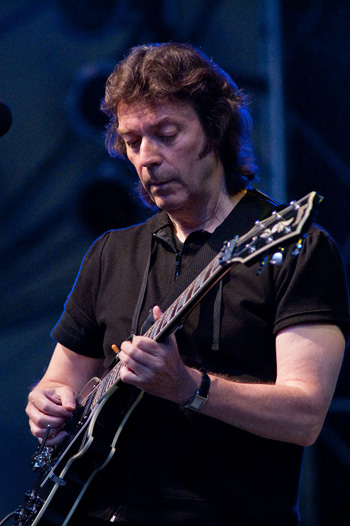
Hackett's guitar playing is astounding - one minute he is chiming chirpingly and you are dreaming of Brit-pop of the ages, whether it be The Fab Four or XTC, then you blink and he is pushing a crescendo of rapid fire distortion through the atmosphere with his Fernandes Sustainer and Whammy pedal. His histrionics are equally acrobatic and lyrical - for all his shredding (and there is a good deal), his playing is marvelously melodic and in a most unpredictable manner. His style is his own, and his musicianship is developed to the point whereby his inspirations are a long forgotten memory, replaced by his own stamp of creativity. If Squackett were the work of a new talent we'd have a new guitar super hero - as it is we simply have an underrated one.

Chris Squire brings to the table much of what he has always brought. His wickedly wonderful bass playing, marked by the unmistakable tone of his signature series Rickenbacker 4001S coming through a combination of amps and effects, and most generally including a 100 watt Marshall guitar amp, has never been more welcome. Almost identifiable as his playing is his angelic vocal cords, which rang so soothingly next to Jon Anderson's for so many years and records with prog superstars, Yes. Here, the vocals are shared with Hackett (each singing lead on their own compositions) - they weave in, out, and around one another as if they have been doing so forever. Harmonies, unisons, and stacked vocal configurations abound as the vocals throughout the album bring to mind CSN&Y, and The Hollies as much as the pair's prog past. While admittedly there is not a lead voice as distinctive as Anderson in Yes, or Gabriel in Genesis, you will still walk away having listened to one of the most impressive vocal productions in a great while. In a day when harmony, background, and group vocals are relatively rare, this album is a vocal treasure chest.

The album also has a somewhat secret weapon - it comes in the form of longtime a Hackett cohort, producer and keyboardist Roger King. Throughout the proceedings, King does a fantastic job. To my ears this is everything the last Yes album wasn't, but should have been. As a producer, he has done a marvelous job of putting together a record that sounds wonderfully cohesive, especially given that in all likelihood there was little time to woodshed the material, or for the band to spend much time actually in the same room. This is just part of the way that many project type records are made these days due to economic necessity and the fact that a musician can't stand still for long and earn his daily bread. The job that's been done here is pretty great - much akin to the job done by Bill Evans and the members of Flying Colors on their stunning debut earlier this year.

King also provides fabulous atmospheric keyboards on every cut, proving the essential glue that holds together the huge instrumental talents of Squackett. This record sounds like a band, as opposed to this song by Squire, this song by Hackett - there isn't the tremendous amount of challenging interplay that existed in 1970, but it's important to realize that firstly, that is not what these two have set off to create, and secondly, that type of instrumental sophistication requires a great deal of time, rehearsal, and collaboration that is again just not always possible in this day and age. It's not just prog, look at the dearth of cool jazz fusion, or even elaborate pop. You'll not soon see again the like of Sgt. Pepper in this market. That having been said, you should be even more impressed by the job that has been done here. Hackett did well to bring King into this project, and King has done a masterful job.

The songs....

A Life Within A Day - Epic prog/pop. There are those who say mentioning Zeppelin here is inappropriate, but that would be like not acknowledging the 800 pound gorilla in the corner. Of course the chugging, mid-tempo, Eastern riffing evokes Kashmir. However, there is also the fabulous intro that is pastoral and elegant. Then there is the solo section that takes off on an incredible path, leaving behind anything reminiscent of LZ's blues rock - Hackett lets loose with some heavily effected, dissonant squalling that somehow remains wonderfully melodic, as Squire underscores his soloing with some characteristically furious busyness. As these two instrumental giants joust, Roger King is fast in the thick of it, and the entire section becomes a fantastic journey that finds the listener gripping his chair, and holding his breath. Alas, they pull out of it having avoided disaster and then it's back into the now familiar riff, and vocals that by now have you singing along. Amazing as the rifled riffing is here, it is the song you walk away singing.

Tall Ships - Enters with Hackett gently playing some acoustic guitar that ends with a brief flamenco flourish after which Squire brings some fabulously funky bass work into the mix. This swings and dances a bit much for prog, as drummer Jeremy Stacey provides some Purdy-esque fatback beats and Hackett joins in with rhythmic stabs that would make Nile Rodgers grin. The melody comes in and it's a cool combination as East meets West - imagine a Crosby, Stills, and Nash album with some vindaloo on the side, and you're about there. A great chorus, and another brilliant Hackett solo. The harmonies are tight and intoxicating, and if there was still real radio, this would be a big summer smash.

Divided Self - A great dose of Brit pop that's wise lyric may be lost in the happy sonic landslide that sees both Steve and Chris strapping on Rickenbackers to perfect effect - Hackett both chimes and plays great fills (exactly in the style of the great tradition) as Squire reminds us that XTC's Colin Moulding may have listened to a few Yes albums on his way to greatness. It's a joy to listen to Squire playing marvelously busy, melodic, and effective bass under Hackett's solo. Two absolute masters of their craft - you can almost hear them listening to one another and reacting in the instrumental sections. If there's not enough playing on this record, you're really not listening very closely.

Aliens - A Squire tune that sees Hackett, King, and Stacey providing some gentle backing that keeps things moving while the bassist weaves his tale of extraterrestrial possibilities.

Sea Of Smiles - This song is going to set the bar awfully high for this summer's later entry in the prog/pop sweepstakes when John Wetton brings out this year's new model of Asia. If this had been released in 1980 it would have seen Squackett jetting to gigs with their name etched upon the back of a big bird's ass. This is a great piece of songwriting, and it's sweetened by loads of cool chops, great choral vocals, and another stunning Hackett solo. King's keyboards are outstanding on this cut - one minute he's playing rapid arpeggios, then he's back to plucky atmospherics, and soothing sheens of synth-work.

The Summer Backwards - More folkish, pastoral harmonies, and some gorgeous melodies abound that again seems to having Squackett thanking Andy Partridge for thanking them. This would fit lovely on XTC's Skylarking, one of the truly classic summer pop records. This one is Hackett's, and it is much lighter in tone and mood than much of his recent solo output.

Stormchaser - A bit of Squackett metal. Very reminiscent of Hackett's solo rock, and it makes me wonder how Hackett has avoided greater acclaim. You can literally hear the band being formed on this cut. It's an early arrival and you can sense that this was the jumping off point. Squire's bass is belligerent and rude - it's clearly Hackett's riff, but the bass man is making his presence well felt. This will be a barnburner when these fellows hit the boards.

Can't Stop The Sun - I get the sense that Chris Squire has finally got his well-deserved obsession with The Beatles out of his system a bit with Squackett. The marriage of melody, harmony, and a bass driven engine is beautifully executed, and we have another tale of the philosophies of love that is as pleasant in the light of day, as it is at midnight. That's a fascinating thing about this album - I've noticed that it delivers a wealth of sunshine and sunny weather, but also has a nice undercurrent that makes it quite good after midnight.

Perfect Love Song - The album's second absolute classic, and the perfect second side for the double sided single, next to Sea Of Smiles. This is all about the ear candy - it's gorgeous, well conceived, and executed with stunning precision. If you have qualms with this, I only ask - do you have a better piece of prog/pop up your sleeve? Great writing, much more than proficient playing, wonderfully soothing vocals, and a flash guitar solo. You kidding? This is great stuff. In the words of Steve Hackett, "A Perfect Love Song celebrates music and love. Just when you think that life is cast in slabs of grey stone, love kicks in and transforms everything. The song has an ascending chord sequence and upbeat lyrics, rounding off one of the most rewarding projects I've been involved with."

So, I'll end where I started with a simple question.

What shitty band are you in? Really, if you are amongst this record's critics, I'd love to hear what you have better to offer. In the meantime, lighten up and enjoy a cool, cool piece of music.

If this was a record by a bunch of unknowns, I suspect it would be lauded widely. If it had been released in 1972 as a side project between Yes and Genesis albums, it would have been acclaimed as the great success that it is.

Squackett is a great record. It does exactly what Squire and Hackett set out to do - record an album of songs that well represents their careers and talents. I congratulate and thank them, as I am personally enjoying it tremendously. It hasn't left my presence since it arrived, and it will most likely be a major part of the soundtrack to my summer. With that, I am well pleased.

My thanks to Steve Hackett, Jo Hackett, and Esoteric Antenna/Cherry Red Records.